jeudi 31 octobre 2019
OUATIH: Scène coupée
Une scène coupée avec Julia Butters refait surface à l'occasion de la ressortie de Once Upon A Time In... Hollywood dans les salles américaines. Le blu-ray sortira le 14 décembre prochain avec 20 minutes de scènes supplémentaires.
vendredi 25 octobre 2019
OUATIH: Nouveau montage et nouvelle sortie ciné
OUATIH encensé, OUATIH critiqué, OUATIH censuré oui mais OUATIH remonté! Tarantino va nous proposer un nouveau montage avec quatre scènes supplémentaires, soit dix minutes de rab' à l'écran, pour une nouvelle exploitation en salle pour occuper le terrain et les esprits en plein sprint pour les prix de fin d'année. Le film ressortira dans 1000 salles, sur sol US uniquement. Reste à savoir ce qu'il y aura de neuf à se mettre sous la dent: on parle de plus de Manson ou de certains rôles coupés (Tim Roth en valet de Pacino ou James Marsden en Burt Reynolds) mais aussi d'une scène de Julia Butters qui pourrait lui valoir une nomination à l'Oscar selon David Heyman, producteur du film.
mercredi 23 octobre 2019
Tarantino vs La censure chinoise
Tarantino avait été vivement critiqué par la fille de l'acteur, Shannon Lee, pour une scène où son père, ridiculisé, se bat contre le personnage de Brad Pitt, Cliff - qui prend l'avantage. Le réalisateur s'était défendu en arguant qu'il n'avait fait que dépeindre l'arrogance bien réelle de Lee et que Cliff était un personnage fictif auquel on pouvait prêter des qualités supérieures à celles de son adversaire. En amont de la sortie du film en Chine, Shannon Lee aurait alors adressé une demande de modification de la scène à l'administration en charge du cinéma sur le territoire chinois.
Les producteurs du dernier film de Tarantino comptaient sur sa distribution en Chine, estimant que le marché chinois aurait permis à Once Upon a Time... in Hollywood de dépasser les 400 millions de dollars de recettes - le film en a jusqu'ici généré 366 millions. Toutefois, Tarantino n'a pas l'intention de renvoyer son film en salle de montage, d'après les informations du Hollywood Reporter, qui n'a pas obtenu de réaction de la part de Sony Pictures Entertainment, qui détient le film.
Dans les contrats que signe le cinéaste avec ses producteurs et distributeurs à chaque nouvelle réalisation, une clause stipule que Tarantino détient les droits sur le final cut. Sans son accord, aucun changement n'est donc possible. Or la Chine n'obtiendra probablement pas satisfaction tant qu'elle se refusera à communiquer les raisons précises de l'annulation de la sortie du film.
La distribution du film aurait pourtant marqué la première sortie digne de ce nom d'un film de Tarantino dans le pays, après la sortie ratée de Django Unchained en 2012 : les scènes jugées trop violentes avaient été coupées - avec l'accord du réalisateur -, retardant d'un mois une sortie qu'avait court-circuitée le trafic d'une version pirate.
Source: Les Inrocks
lundi 14 octobre 2019
QT8: la critique de Film Threat
Documentary QT8: The First Eight is director Tara Wood’s wonderfully exuberant and satisfying retrospective of the work of American auteur Quentin Tarantino. The documentary tracks Tarantino from his beginnings working in a video store in Manhattan Beach, to his time as a screenwriter, eventually parlaying the earnings from an early script, and from a TV appearance as Elvis impersonator on The Golden Girls, into the production of Reservoir Dogs. He’s been a mainstay of film ever since.
Twenty-one years after the release of Reservoir Dogs, the darling director of the Indie film scene is now arguably so popular and successful that he is maybe not so Indie anymore. This hardly matters as long as Tarantino keeps making films that express, above all else, his love for the art and film history during his lifetime in a way that resonates with hardcore fans and annoys everyone else.
samedi 12 octobre 2019
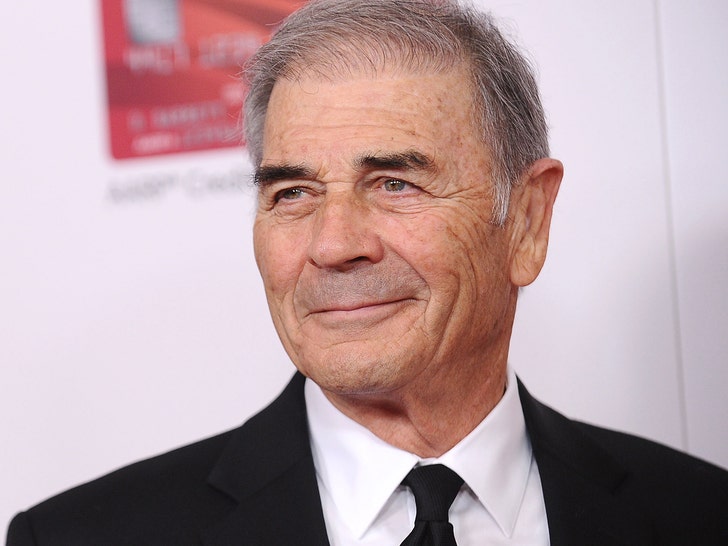
Robert Forster 13 juillet 1941 - 11 octobre 2019
Robert Forster, nommé aux Oscars en 1998 pour sa performance dans Jackie Brown de Quentin Tarantino, est mort vendredi 11 octobre à l’âge de 78 ans, a annoncé son attaché de presse à The Hollywood Reporter. Né à Rochester (Etat de New York), il est décédé des suites d’un cancer au cerveau à son domicile à Los Angeles.
Pour beaucoup, il restera Max Cherry dans Jackie Brown,
un personnage que Quentin Tarantino avait imaginé pour lui. Abonné aux
seconds rôles, il a été vu dans plus de cent films, dont Mulholland Drive de David Lynch et The Descendants d’Alexander Payne. Plus récemment, Robert Forster interprétait Ed dans la série à succès Breaking Bad et le film El Camino : A Breaking Bad Movie.
mercredi 9 octobre 2019
Pulp Fiction Locations: 25 years after
Le Los Angeles Mag a publié un très beau papier sur les lieux de tournage de Pulp fiction 25 ans après. Après Once Upon A Time In... Hollywood, c'est donc une nouvelle ballade dans un Los Angeles partiellement disparu que nous propose, indirectement Quentin Tarantino:
vendredi 4 octobre 2019
QT8: the First Eight
A journey through the films of Quentin Tarantino, narrated by the collaborators who know him best. QT8: The First Eight is coming to theaters for ONE NIGHT ONLY October 21st!
Get tickets now: bit.ly/QT8fathom #QT8
How Quentin Tarantino got the ‘60s sound for ‘Once Upon a Time in ... Hollywood’
For a
brief moment in his then-young rock career, Mark Lindsay lived in a
gorgeous home at the top of Benedict Canyon. The singer-songwriter,
co-founder of the group Paul Revere & the Raiders, moved there with
his buddy, record producer Terry Melcher, in the late ’60s. He wrote
some of his band’s best work there, including the single “Good Thing,”
which he penned on a piano in the living room.
Lindsay left the house when Melcher wanted to live with his girlfriend, actress Candice Bergen. They soon rented the place to director Roman Polanski and his wife, Sharon Tate.
What happened next in that living room inaugurated one of the darkest weeks in L.A. history. But Lindsay still remembers the place fondly, even if he did once bump into Charles Manson at a party there.
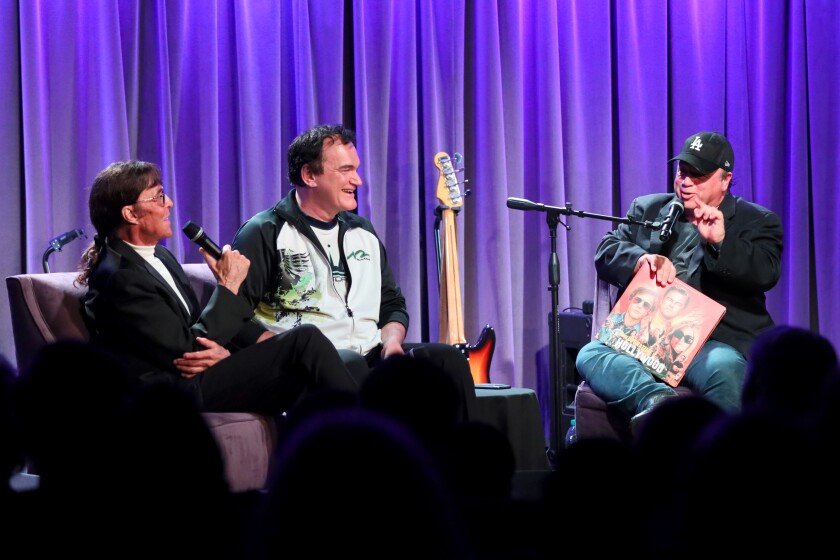
“Those two years were my golden years,” Lindsay said onstage at the Grammy Museum on Wednesday night in conversation with director Quentin Tarantino. “I remember drinking rosè in the garden with Terry outside in that liquid sunshine and saying, ‘it doesn’t get better than this’ and thinking it’ll never get worse. It didn’t until 1969.”
For director and L.A. native Tarantino, however, the coincidence is a thread that ties his whole film “Once Upon a Time … In Hollywood” together. All of his obsessions — vintage rock and roll, movie-business lore, darkly comic idylls cut through with horrific violence — wound through that property at the top of Cielo Drive (it’s now demolished, of course). He and Lindsay talked about evoking that golden era of L.A. rock radio in “Once Upon a Time …” and how it set the tone for the nightmare to come.
“Paul Revere & the Raiders was exactly the kind of band that would have rocked my little socks off,” Tarantino said of Lindsay’s pre-fab conceptual, velvety-voiced act. “And the reason Manson knew of Terry Melcher was because of Paul Revere & the Raiders.”
“Once Upon a Time …” was the rare original summer flick to best $100 million at the box office this year. The star-packed throwback follows a TV actor (Leonardo DiCaprio) and his loyal stuntman sidekick (Brad Pitt) through the wane of their careers in late-’60s L.A., all while something evil kindles in the canyons over the hill.
Throughout the film, Lindsay’s songs help set the hyper-specific tone of the era’s music — less the raw psychedelia of the tastemaking historians and more the amber hues of the innocence that Manson would soon shatter. Though Margot Robbie’s Sharon Tate pokes fun at the band in the script (“Don’t tell Jim Morrison you’re dancing to the Raiders!”), their slinky, creepy song “Hungry” plays as she meets her eventual killer for the first time in the driveway.
It’s by now no spoiler to say the film takes some liberties with the actual events the night of the Manson murders. But for Lindsay, Tarantino’s vigilant re-creation of the scene — down to the actual sheet music in the actual piano from the living room that night — was beyond uncanny.
“The room where Abigail Folger slept was my room,” Lindsay said. “It’s just like I’m back again.”
On Wednesday, even Tarantino’s conversation was peppered with such callbacks. Onstage, moderator David Wild, a rock journalist and Grammy scriptwriter, got a text from another favorite Tarantino soundtrack source, Neil Diamond, suggesting the director sync a few more tunes in his next project. Tarantino’s movies have always mined vintage rock for unexpected revelations and new contexts, ever since his impeccable use of Dick Dale’s “Misirlou” in Pulp Fiction.
“I want to be known for my discography as much as my filmography,” Tarantino said. When he’s picking soundtrack cuts, he joked that he imagines that “every director I know is in there going ‘Oh god, now I have to get out of the business’.”
“Once Upon a Time …” was a chance to marinate ever deeper in the era’s AM radio (especially the old L.A. station KHJ). Tarantino and music supervisor Mary Ramos unearthed around a full daytime block’s worth of recordings from the era for research — ad jingles, DJ patter and all. Drive-time radio wasn’t just a historical reference point in the film, he said, but a way to set the ambience in the eternal, doomed summer of ’60s L.A. at the margins of the movie business.
“There’s an L.A. quality to Brad Pitt’s character where he works in Hollywood but doesn’t live there,” Tarantino said. “He’s given his life to the entertainment business but doesn’t have anything to show for it. He drives home to Panorama City, and in that time you hear four songs, which gives you an idea of how long it takes to drive there.”
For Lindsay, the return to the stage has indeed been a long drive through a career that, if he hadn’t lived it, could have been scripted by Tarantino. It wasn’t all L.A. classic rock; Lindsay performed the synth score for the 1980 Japanese action flick “Shogun Assassin,” a favorite sample source for the Wu-Tang Clan and other rappers.
But on this night, he did his best to invoke the mood of “Once Upon a Time,” performing three songs from the movie with a choral ensemble from Orange County’s Tesoro High School.
Lindsay’s voice still had that velvety touch that made long, aimless drives through the Hollywood flatlands so moody back then. Tarantino almost always makes stars of his deep-cut soundtrack picks, but this was something else: an ever-rarer chance to hear the actual voice ringing through that house on Cielo Drive, back before everything went dark.
Lindsay left the house when Melcher wanted to live with his girlfriend, actress Candice Bergen. They soon rented the place to director Roman Polanski and his wife, Sharon Tate.
What happened next in that living room inaugurated one of the darkest weeks in L.A. history. But Lindsay still remembers the place fondly, even if he did once bump into Charles Manson at a party there.
“Those two years were my golden years,” Lindsay said onstage at the Grammy Museum on Wednesday night in conversation with director Quentin Tarantino. “I remember drinking rosè in the garden with Terry outside in that liquid sunshine and saying, ‘it doesn’t get better than this’ and thinking it’ll never get worse. It didn’t until 1969.”
For director and L.A. native Tarantino, however, the coincidence is a thread that ties his whole film “Once Upon a Time … In Hollywood” together. All of his obsessions — vintage rock and roll, movie-business lore, darkly comic idylls cut through with horrific violence — wound through that property at the top of Cielo Drive (it’s now demolished, of course). He and Lindsay talked about evoking that golden era of L.A. rock radio in “Once Upon a Time …” and how it set the tone for the nightmare to come.
“Paul Revere & the Raiders was exactly the kind of band that would have rocked my little socks off,” Tarantino said of Lindsay’s pre-fab conceptual, velvety-voiced act. “And the reason Manson knew of Terry Melcher was because of Paul Revere & the Raiders.”
“Once Upon a Time …” was the rare original summer flick to best $100 million at the box office this year. The star-packed throwback follows a TV actor (Leonardo DiCaprio) and his loyal stuntman sidekick (Brad Pitt) through the wane of their careers in late-’60s L.A., all while something evil kindles in the canyons over the hill.
Throughout the film, Lindsay’s songs help set the hyper-specific tone of the era’s music — less the raw psychedelia of the tastemaking historians and more the amber hues of the innocence that Manson would soon shatter. Though Margot Robbie’s Sharon Tate pokes fun at the band in the script (“Don’t tell Jim Morrison you’re dancing to the Raiders!”), their slinky, creepy song “Hungry” plays as she meets her eventual killer for the first time in the driveway.
It’s by now no spoiler to say the film takes some liberties with the actual events the night of the Manson murders. But for Lindsay, Tarantino’s vigilant re-creation of the scene — down to the actual sheet music in the actual piano from the living room that night — was beyond uncanny.
“The room where Abigail Folger slept was my room,” Lindsay said. “It’s just like I’m back again.”
On Wednesday, even Tarantino’s conversation was peppered with such callbacks. Onstage, moderator David Wild, a rock journalist and Grammy scriptwriter, got a text from another favorite Tarantino soundtrack source, Neil Diamond, suggesting the director sync a few more tunes in his next project. Tarantino’s movies have always mined vintage rock for unexpected revelations and new contexts, ever since his impeccable use of Dick Dale’s “Misirlou” in Pulp Fiction.
“I want to be known for my discography as much as my filmography,” Tarantino said. When he’s picking soundtrack cuts, he joked that he imagines that “every director I know is in there going ‘Oh god, now I have to get out of the business’.”
“Once Upon a Time …” was a chance to marinate ever deeper in the era’s AM radio (especially the old L.A. station KHJ). Tarantino and music supervisor Mary Ramos unearthed around a full daytime block’s worth of recordings from the era for research — ad jingles, DJ patter and all. Drive-time radio wasn’t just a historical reference point in the film, he said, but a way to set the ambience in the eternal, doomed summer of ’60s L.A. at the margins of the movie business.
“There’s an L.A. quality to Brad Pitt’s character where he works in Hollywood but doesn’t live there,” Tarantino said. “He’s given his life to the entertainment business but doesn’t have anything to show for it. He drives home to Panorama City, and in that time you hear four songs, which gives you an idea of how long it takes to drive there.”
For Lindsay, the return to the stage has indeed been a long drive through a career that, if he hadn’t lived it, could have been scripted by Tarantino. It wasn’t all L.A. classic rock; Lindsay performed the synth score for the 1980 Japanese action flick “Shogun Assassin,” a favorite sample source for the Wu-Tang Clan and other rappers.
But on this night, he did his best to invoke the mood of “Once Upon a Time,” performing three songs from the movie with a choral ensemble from Orange County’s Tesoro High School.
Lindsay’s voice still had that velvety touch that made long, aimless drives through the Hollywood flatlands so moody back then. Tarantino almost always makes stars of his deep-cut soundtrack picks, but this was something else: an ever-rarer chance to hear the actual voice ringing through that house on Cielo Drive, back before everything went dark.
Source: Los Angeles Times
mardi 1 octobre 2019
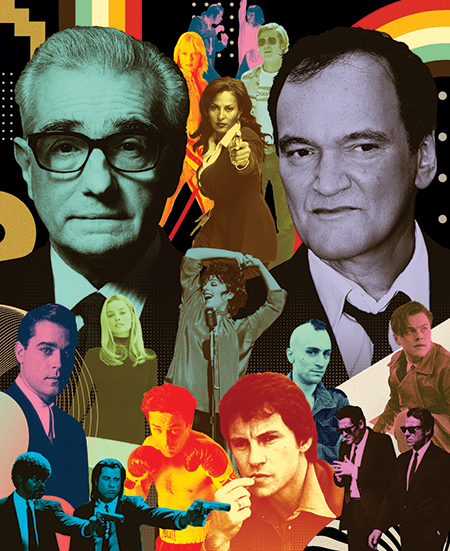
DGA Quarterly Magazine: Martin Scorsese & Quentin Tarantino
Martin Scorsese and Quentin Tarantino talk movie obsessions, director heroes, process and violence as catharsis.
Martin Scorsese and Quentin Tarantino are born storytellers, not just in their movies—which bear each director's unmistakable stamp—but in their deep-seated appreciation for the medium. While they hail from different generations—Scorsese was among the first wave of film school grads in the mid '60s, and Tarantino's rise coincided with the indie film revolution of the early '90s—their passion and knowledge of cinema place them on equal footing. No genre escapes their grasp, whether it's prestige studio releases or B-movie potboilers, splashy musicals or noirish thrillers, art-house fare or spaghetti Westerns. They've been dining on this grand buffet all their lives, and it shows in their own work, in the characters they've created, and the lens through which they view the world. This is a particularly conspicuous year for both filmmakers: Tarantino's Once Upon a Time… in Hollywood has galvanized critics and audiences alike since its debut at Cannes, while anticipation runs high for Scorsese's The Irishman, for which the director has spent considerable time in post dealing with digitally de-aging his leads. The two sat down for the DGA Quarterly to talk directors, influences and violence as catharsis, among other topics. This is an edited version of their conversation. –Steve Chagollan
Martin Scorsese: I just finalized the last cut on (The Irishman).
Quentin Tarantino: I
get a situation when I kind of get down to that very, very end, where
it's like, "Let's try this" and "Let's try that." But we get to that one
spot and then I go home that night and I think, "You know, that was
horrible. I've got to put it all back in the next day."
MS: This has taken over
three months because, in a funny way, this particular film I didn't
really screen that much because the last six months have been dealing
with the de-aging.
QT: Yeah, yeah.
MS: And so we're doing
that and it's quite intense. And so the ending is like two shots and I
put another shot in. Then, [I'm thinking], "Wait, does it need that
medium shot? Maybe we would just stay with the wide shot." So we tried
that a few times, and then a couple of friends said, "Didn't you have
another shot in there?" I said, "Yeah, maybe that's better." But the
thing was, that in so doing, it changes the length of the last wide
shot.
QT: Well, let me ask
you a question about the movie you're doing now because you're dealing
with, I think, the longest canvas you've dealt with. It's quite a few
hours, right?
MS: Yeah.
QT: So how has that affected you as far as pacing is concerned?
MS: Interestingly
enough, I figured out the pacing on the page this time with the script
that [Steven] Zaillian [wrote]. And then—this is a complex situation
because of the fact that it's being made with Netflix—it kind of
stretches the length. In other words, I'm not sure if it had to be, for
example, a two hour and 10 minute movie. Or could I have been at four
hours?
QT: Right, yeah.
MS: I'm not certain as
to the ultimate venue, so I made it pure in my head in a sense like,
"What if it's just a movie? What if it's got to be as long as we feel or
as short as we feel?" And, because the nature of the
characters—basically, one character is telling the story in flashback at
the age of 81.
QT: Uh-huh.
MS: And when you get
to my age, Quentin—and you get a little slower, a little more
contemplative and meditative—it's all about thinking of the past and
about [the characters'] perception of the past and so, by the third shot
in the picture,
I felt it in the editing. And I said, "Let's see where it takes us and play to a few audiences and see how they tolerate it or not."
So we kept saying, "We should try this and that." And also the nature of the computer-generated stuff we were doing gave us a certain pace.
I felt it in the editing. And I said, "Let's see where it takes us and play to a few audiences and see how they tolerate it or not."
So we kept saying, "We should try this and that." And also the nature of the computer-generated stuff we were doing gave us a certain pace.
QT: Yeah, yeah, okay.
MS: It's a quieter
pace. It still has violence to it, it still has humor. But it comes in
different ways. It's the old story: The more pictures you make, the
more there is to learn.
QT: You know, Marty,
I'll tell you an interesting story that I'm going through right now, and
I thought it would lead to a very good question about you and movies,
so let me go with this.
Right now, I'm working on a book. And I've got this character who had been in World War II and he saw a lot of bloodshed there. And now he's back home, and it's like the '50s, and he doesn't respond to movies anymore. He finds them juvenile after everything that he's been through. As far as he's concerned, Hollywood movies are movies. And so then, all of a sudden, he starts hearing about these foreign movies by Kurosawa and Fellini…
MS: Yeah, yeah, yeah.
QT: And so he's like, "Well, maybe they might have something more than this phony Hollywood stuff."
MS: Right.
QT: So he finds himself
drawn to these things and some of them he likes and some of them he
doesn't like and some of them he doesn't understand, but he knows he's
seeing something.
MS: Uh-huh.
QT: So now, I find
myself having a wonderful opportunity of, in some cases, rewatching and,
in some cases, watching for the first time movies I've heard about
forever, but from my character's perspective. So I'm enjoying watching
them but I'm also [thinking], 'How is he taking it? How is he looking at
it?' I always like to have a good excuse for just throwing down into a
pit of cinema, so that brings me to ask you: When was it for you that
you started being lured away from what you considered Hollywood movies,
and started becoming more adventuresome and going outside of your
neighborhood to actually see some of the other foreign films that you'd
been maybe reading about?
MS: Well, it's a great
question because my first seven, eight years or so of my life we were in
Corona, Queens. And then my father had to move back to Elizabeth Street
(in Lower Manhattan's Little Italy), the street he and my mother were
born on, because of some problems with the landlord. And so I was thrown
into what looked like the Dead End Kids [or] Lionel Rogosin's On the Bowery, you know?
[laughing]
But prior to that, probably because of the asthma, [my parents] would take me to the movies all the time. So I saw Duel in the Sun, [that] was the first one. And then The Wizard of Oz, The Secret Garden, noirs like The Threat, [by] Felix Feist. Did you ever see that?
QT: Yeah, yeah. Loved The Threat.
MS: And so and [Robert Wise's] Blood on the Moon. [William Seiter's] One Touch of Venus.
[We] had a little television set, a 16" RCA Victor, and my grandparents
would come over on a Friday night because they were showing Italian
films for the Italian community. And the films were [Vittorio De Sica's]
Bicycle Thieves; [and Roberto Rossellini's] Rome, Open City and Paisan. And so at 5 years old, I saw the reaction of my grandparents crying watching Paisan
and I heard the language that was the same as they were speaking. And
so I knew there was another kind of cinema, but it wasn't the movies.
QT: Yeah.
MS: The first film I saw about Hollywood was [Billy Wilder's] Sunset Boulevard.
QT: Right, yeah. [laughing] Very dark view of Hollywood.
MS: And so in a sense,
they were codified—the truth was coming through a different code, and a
different culture in a way. And it didn't make them any less [important]
from the European films I saw. But there was something that affected me
when I saw those Italian films on that small screen that I never got
past, and so that changed everything.
That really gave me a view of the world, the foreign films. It made me curious about the rest of the world, apart from the Italian-American Sicilian community I was living in.
QT: So did it even open
you up to New York, in a way—reaching those other cinemas, going
outside of your neighborhood, searching out those places?
MS: It was more than that. Because it was really going into America, outside of the little village that I grew up in.
QT: Oh, yeah, I get you.
MS: It was scary. There
were a lot of bad areas, so you'd go with some friends. Did you ever go
to the 42nd Street when all the movies were playing at that time?
QT: You know, I never made it. As a matter of fact, the first time I ever went to New York was for one weekend of casting Reservoir Dogs.
Now understand, I wanted to go to New York since the minute I heard
that there was a New York and watch a New York cinema [bill]. But no one
ever took me when I was a kid, and I couldn't afford to go when I was
old. So we're casting the movie and Harvey Keitel was like, "I can't
believe we're not going to give the New York actors a shot here." And I
go, "Well, we can't afford it." He goes, "Well, I'll tell you what. I'll
arrange for a weekend of casting through a casting director and I'll
put you and (producer) Lawrence Bender up, and I'll fly you out." So we
had one weekend in New York casting. And when we come in from the
airport, it's like in the morning, and we're just kind of driving
through New York to get to the hotel, I think it was the Mayflower…
MS: Yeah.
QT: And I'm literally
like, "OK, I've been wanting to go to a Times Square cinema my whole
life. The first thing I'm going to do, as soon as we get done with work,
I'm going to go to the Times Square, I want to go see whatever is
playing." And Harvey goes, "Quentin, no you're not. In a week or two,
you could do that, but you can't do that tomorrow. You're too new." [Scorsese is laughing throughout this story.]
MS: He was so right.
And also the weird thing is that that was changed in the '50s. We'd go
up but you'd have to have about four guys with you. And you go and they
were showing every film you can imagine. There were no sex films. It was
all regular Hollywood films.
We'd go up there and it was a dangerous place, you know, it was crazy. And they would show, you know, The Elusive Pimpernel, directed by [Michael] Powell and [Emeric] Pressburger and on the same bill, Ulysses with Kirk Douglas, and beautiful Technicolor prints. But, across the street, they had Halls of Montezuma [and] To the Shores of Tripoli.
QT: Yeah.
MS: Two films. One (Halls)
I think is a Lewis Milestone, the other [Bruce Humberstone], and so
they were beautiful Technicolor films. Right? They showed them black and
white! [Tarantino laughing] And we'd go in the place, God
knows what was going on in the balcony—there were fights, all kinds of
stuff—but we went anyway. All of the prints were black-and-white prints,
of like (John Ford's) Drums Along the Mohawk—black-and-white!
QT: [Laughing]
Now, I had that experience in Downtown L.A., the Metropolitan Theatres
there, it was the Cameo and the Arcade (both on S. Broadway). They were
the all-night ones. As a matter of fact, I remember—I think it was in
'82 because they never got an L.A. release—I remember that movie that
Ralph De Vito did, Death Collector, which was Joe Pesci's [first film]…
MS: Yeah, that's how we got Joe for Raging Bull.
QT: Well, I heard it was playing at the Arcade. And I go, "Wow," it was like right after the Raging Bull.
I go; that's the movie. The only way to see it was to go there at four
in the morning. I'm not going to go there at eight at night.
MS: Death Collector,
Bob (De Niro) saw it on CBS. He said, "I saw this thing on TV, and this
guy is really interesting," so we got a print of it. That's how we
looked at it, you know?
QT: It's a good film. When I actually saw it. It was like, "Oh, wow, this is like an exploitation version of Mean Streets."
MS: You're right! [laughing]. Now the repertories are gone, of course, so, it's a different thing entirely.
QT: Well, just so you know, I own a repertory theater out here in Los Angeles, the New Beverly, and we do great with your films.
MS: Oh, thank you.
QT: And we only show 35 or 16 [mm]. And we have a full trailer collection.
New York vs. L.A. School of Cinema
QT: When I think of New
York filmmakers, I think of you, Marty. I think of Sidney Lumet. I
think of Woody Allen. But also, you're part of the New York New Wave,
which was the '60s. You had the '60s shoestring guys, like you and Jim
McBride and Shirley Clarke and Brian De Palma. I'm interested in that
whole concept of the New York New Wave, and you guys more or less being
inspired by the can-do spirit of the French New Wave. Give me a camera
in sync and I'll attach it to this car and away we go.
MS: Or put it in a wheelchair and just go—a cameraman and a wheelchair and that's your dolly shot.
QT: Right.
MS: The New York thing
sort of came out of postwar. There were very few films still being made
in New York. [In] the studio system, of course, you had the factory. Why
go to New York when you have everything you need in the studio? So what
I think changed it was, of course, again, Neorealism, which was
shooting out in the true actual locations.
QT: Yes.
MS: Slipping into film noir, like [Jules Dassin's] The Naked City and [Otto Preminger's] Where the Sidewalk Ends and everything else, even Force of Evil, [Abraham] Polonsky's film.
QT: Yeah.
MS: [They had] shots of New York, which were amazing. George Cukor, A Double Life, all these films, they actually started to take the cameras into the streets.
QT: Yeah.
MS: And New York was
not a shooting [destination] at that time. You had this traffic, there's
people that have work to do, they'd walk in front of the camera, they
don't want to be told anything. They were hiding the camera in different
places and, ultimately, it was the American avant garde, the films
Jonas Mekas curated in the mid-'50s, Cinema 16. Amos Vogel, Jonas Mekas,
Shirley Clarke [with] The Connection...
QT: Yeah.
MS: (Clarke's) The Cool World. She shot it out in the streets. The man who really broke it, of course, was Cassavetes with Shadows.
QT: Yeah, he's the godfather of that, exactly.
MS: Once I saw Shadows,
I looked at my friends and said, "Well, there's no more excuses." As
long as you have something to say, we can do this. They were using a
[16mm] Éclair [camera], which was smaller and lighter. And that was the
go-to move because we saw you were able to do it and you didn't need the
machine—good, bad or indifferent—of the West Coast.
QT: But the interesting
thing about the New York New Wave, especially when compared to either
Neorealism or the French New Wave is, I'd say, in the French New Wave
movies, they're all taking place in the same town. At any point in time,
Anna Karina's character from [Godard's] Vivre sa vie could bump into the piano player in [Truffaut's] Shoot the Piano Player. I mean, that could absolutely happen.
MS: Exactly. Yeah.
QT: Whereas the New
York New Wave, on the other hand, stuck to their neighborhoods. And
showed us a very multifaceted version of New York. You wouldn't imagine
the characters in The Cool World bumping into characters in [Scorsese's] Who's That Knocking at My Door or the Greenwich Village hippies from [De Palma's] Greetings. They're not going to exist in the same frame.
MS: No, no, no, those
were different countries. We would never go to 110th Street. I don't
know what they do up there. I don't care. It's a different world.
When I went to Washington Square College in 1960, NYU as it's known today, I just went to the corner of Houston and Elizabeth where I lived and made a left, six blocks. That was it. I was in another planet. And then it balanced both. [In] Mean Streets, [they] were kind of both in there, in a way: the outside world and the inside.
QT: I watched, fairly recently, Who's That Knocking at My Door. And one of the things that cracks me up on it is, because I know what a fan of [John Ford's] The Searchers you are, and so you had a whole big scene [on the Staten Island ferry] where [Harvey Keitel's character is] talking about [The Searchers]…
MS: I had to do it, I know.
QT: It is my favorite
scene in the whole movie. In fact, of the New York New Wave, your film
was the most New Wavy looking. It looked a little bit like the French
New Wave movies.
MS: Yeah, the
black-and-white… But yeah, you're actually right. No doubt there was an
influence of the French New Wave, and Bertolucci really; Before the Revolution was a wipeout. And Pasolini; for me, Accattone is the best of all of them, and somehow it translated. I loved what they did with the perforations on the film.
QT: Yeah.
MS: The frames, you
know—when you look at a frame and you're editing with celluloid—ah. It's
sublime. You could cut right on the edge of the frame. You'd go two
frames and pull one out. I mean they were doing it, and we started doing
it ourselves and experimenting.
It was what my old teacher, Haig Manoogian, said when we were shooting these short films at NYU at the time, and we'd get into an editing problem. We'd say, "But Truffaut said when he's cutting a film going one way, he recuts it to go another way." And my professor said, "That's nonsense. He wouldn't do that." Yeah, but we had this shot. He goes, "Listen, the point is that you may shoot a shot for a certain reason and then later when you're in the editing process and things aren't working…" It's like the monolith in [Kubrick's] 2001. You know, you touch the monolith and you take a shot that had nothing to do with that scene…
QT: Yeah.
MS: …And it works in
another place and means something else. He said, "You learn about the
value of the shot itself." The shot itself takes on its own life, and
you can see that in little frames, 16 or 35, it didn't matter.
QT: It's funny you're
saying that because actually one of my favorite things with me and my
editors is basically when we cheat and get away with it, and it's as
obvious as the nose on your face.
MS: It's so obvious. There's a scene in Shutter Island
with this woman who's in the insane asylum and [Leonardo DiCaprio's
character is] interrogating her at a table, very nice woman, and she's
talking about [how] she had killed her husband with an ax. And there's a
shot over her shoulder—which is a very Hitchcock kind of thing; she has
a glass and she takes a sip and puts it down; and cut back to Leo, he's
interrogating her; come back to her; and then another shot over her
shoulder where she takes the glass and goes like this and puts it down
and there's no glass in her hand.
QT: Uh-huh. [laughs]
MS: Well, she was
rehearsing. But I said, "Let's do that." You think there's a glass
there. And hence, the whole story: what's true, what isn't true, what is
imagined.
QT: Oh, that's perfect.
MS: Cheating is…
QT: It's a very honorable thing to do. You just have to pull it off.
MS: That's right. It
takes on its own life. Things you'd think would never cut together, do.
[Then] things you think are just going to be beautiful cut together—a
disaster.
QT: I'm wrapping up my publicity tour on (Once Upon a Time…)
and I get questions like, "What was the most difficult scene for you to
do?" I guess my real answer to that question usually is, if I've got a
big set piece I'm getting ready to do, and it's Tuesday and we start it
on Wednesday. And half of the reason I'm doing the movie is to do this
sequence, which I've watched in my head so I see it. And now, if I don't
do it at least as good [as I see it] in my head, I will at least be the
[only] one who knows that I didn't do it.
MS: That's right. Exactly.
QT: And it's sort of
like me testing my talent. Am I going to hit the ceiling on this one? Am
I not as good as I think I am?
And just before those days, those sequences, are always my most
anxiety-filled, because I want them to be great and I'm at the bottom of
the mountain right now and I'm looking up. I know once I start
climbing, I'll be fine. But I've got to start climbing. You have to get
through that…
MS:[laughing]
It's true, and it's total anxiety, bad dreams, everything. Get in there
in the morning. Nasty, arguing, complaining. And then I want to get
started.
QT: On those mornings, I am the nastiest. I am like, "Don't bother me."
MS: "Don't come near me." [laughing]
I go outside the trailer. I'm very nice to everybody. I go in the
trailer, there's my AD and my producer, my assistant, and they get it.
And then the DP comes and they all get it. And I usually complain about
the traffic or there's something wrong with my teeth or I don't know
what. "Can't do a damn thing around here," you know.
QT: Yeah.
MS: But in any event,
it is that incredible thing that I always talk about: How do we get
these concepts up here, out through all this equipment, through that
lens, with the glass, and how do we get these dreams in our head? It's
so ephemeral.
Once you start to make them physical, we may lose part of what we're feeling up here, what we want to express. It's very tricky.
"I'm
interested in that whole concept of the New York New Wave, and you guys
more or less being inspired by the can-do spirit of the French New
Wave."–Quentin Tarantino
QT: It's an interesting
double-edged sword which, I think, is why we have the anxiety, because,
on the one hand, we've got this perfect movie in our head, but we don't
want that. We want to create something better than that because we
don't have those actors in our head.
MS: Exactly.
QT: You've got to
constantly [be] making the cuts with the music and this and that and the
audience ooh'ing and aah'ing. Yeah, we can maybe do that. But it's got
to have a heartbeat.
MS: That's right.
QT: But I still want all that ooh'ing and aah'ing.
MS: Yeah, I know. I
know, I know. And that's the tension. That's the incredible tension. And
people say, "Well, if you hate it." It's not that I hate it.
QT: No, it's not hating.
MS: It's what we do.
QT: It's actually the most invigorating thing in my life. But it doesn't mean I don't have trepidation.
MS: Oh, God. But you
know, you've tried your best under the circumstances: with the DP, with
your actors, with the weather, with how you're feeling, with that
location, with that shooting schedule. Unless, you know, some people go
back and they reshoot a lot of stuff that they really need.
QT: Yeah, it seems like
cheating to me. There is an aspect of, "No, you've got to pull it off
in the time—either one that you said that you were going to [meet], or
while everyone's all there to do it. Even if you go over, it's still…
MS: That's right. It's like a prize fight.
QT: Anybody could just do an unlimited thing…
MS: Yeah, no, a prize
fight. You've got certain rounds. You've got to get in there and you've
got to keep going and that's it. I mean, I did shoot four extra days, I
think, on The Departed. But what I did there, we were changing
it so much in the middle of the film when we were shooting. I kept
working with [screenwriter] Bill Monahan and everybody rewriting stuff.
It got so complicated that, at one point, my continuity person said,
"Where do you want this new scene [that] just came in?" I said, "Put it
in the middle with everything else. [laughing] I'll figure it
out later." Sure enough, in the end it was like we were wrangling six
wild horses, me and [editor] Thelma [Schoonmaker]. And then finally, we
put it all together and we realized, "Okay, we need this and we need
that."
QT: Yeah, that makes
sense, absolutely. I would have to think, though, that when it comes to
what I was describing about leading up to that big section, feeling
trepidation, I would imagine that you probably felt that way leading to
the big action climax of Taxi Driver.
MS: It was every day on Taxi Driver.
It was supposed to be a 40-day shoot and we went 45 days and they were
very, very upset with us—really upset, angry, coming down, phone calls.
It was a nightmare. And I must say, the energy you see in the frames—and
I designed that whole shootout sequence very carefully—there was a good
kind of anger that kept us going.
QT: Yeah.
MS: It took a lot out
of us, but it was like being in a battle. It was fight, fight, fight,
all the way through everything. It's like everything you did was a
battle to get the shots you wanted, how you wanted it. We were just
trying to fight the time.
QT: Yeah.
MS: But it had a crazy energy to it. Because of that, we were like commandos.
QT: That makes sense,
in particular that cathartic action scene and pulling it off, because
it's, on one hand, operatic, even Japanese style to some degree.
MS: Yeah, yeah.
QT: But also more
realistic than anything I'd ever seen in just a normal, go-to-the-movies
kind of movie theater experience. That ending has got to be cathartic.
That brings all these elements together. Also, you're giving us an end
to a movie. We've watched this guy in his apartment forever and now this
it, the fuse has met the bomb basically.
MS: Oh, yeah, yeah,
yeah. The thing was, [Paul] Schrader wrote that and it was very, very
personal. And he had imagined—I'm putting words in his mouth I guess—but
the impression I got was he wanted it more Japanese and more stylized.
And he, I believe, said he would have wanted more blood on the walls. I
said, "But I'm not Kon Ichikawa. Or [it's not Kurosawa's] Sanjuro…
QT: Yeah, where you trigger the sprinkler system basically.
MS: I watch those
things. I said, "I can appreciate it. I love it. But every time I try to
do it, it comes out another way." Because where I come from, Quentin,
when I saw violence or the threat of violence, it was very real.
QT: Yeah.
MS: Very serious and
there were great repercussions. And, you know, problems that dealt with
that, whether it's a slap in the face or a look, even, boom!, people
just stopped, and you could be dead the next minute. You don't know. I
just did it the way I imagined… as if it would happen realistically.
QT: I heard you say at
the time that you were kind of disturbed that audiences were thinking
[of the scene] cathartically but, to me, it seems like it is made to be
cathartic.
MS: But I didn't know
that. I thought it was a special passion project that had to be made
because we all had those feelings. I had feelings of this disconnect and
this rage. But the rage, I mean, ultimately, we don't cross that line
that [the title character] Travis crosses. But we understood it and we
didn't have to say much about it.
QT: Yeah, yeah. You just didn't know how much you would actually tap—how deep the vein was.
MS: I thought nobody was going to see the film.
QT: So my question, in Taxi Driver,
it's like I'm sure the reason the movie, when it came to actually
getting made (at Columbia) because it is vaguely similar enough to Death Wish…
MS: (Producers) Michael and Julia Phillips, who had just won the Academy Award for The Sting,
were really pushing the picture and working with the people at
Columbia—at that time it was David Begelman—and they got it made. But
[the studio] did not want to make it, and they made it very clear every
minute.
QT: Oh, really. [laughing]
MS: Every day. And
especially when I showed it to them, they got furious, and [it] also got
an X rating. And I always tell the story that I had a meeting with
Julia and myself and the Columbia brass. They looked at me. I walked in,
ready to take notes. They said, "Cut the film for an R or we cut it.
Now, leave."
QT: Jesus!
MS: I had no power at
all. There's nothing I could do. I came up against a monolith, and the
only people who were able to pull it through were Julia and Michael. But
meetings, talks, and then, of course, dealing with the MPAA to shave
and trim a bit here and there. Again, because, in doing the shootout, I
didn't know how else to present it. Maybe knowing that some of it was
artifice, I didn't realize the impact of the imagery. So I cut two
frames and walked out.
I mean, the violence, it's catharsis, it's so true. I felt it when I saw The Wild Bunch.
QT: Well, that's an interesting thing. For instance, I feel a catharsis at the end of Taxi Driver.
MS: And the character (in Taxi Driver), 80% or 90% of it was De Niro himself.
QT: Absolutely.
MS: With that look on his face and his eyes.
QT: It's interesting
because the thing about it is, you, De Niro and Schrader made a choice
to look through Travis' eyes. [De Niro] went inside of Travis. This is a
first-person study. You're seeing the world through his eyes. So if
he's a racist, you're looking at the world through the view of a racist.
MS: Right, exactly.
QT: Nevertheless,
though, in Travis' one-against-all stand against the pimps, I'm on
Travis' side. I mean, if we're not supposed to root for him even a
little bit, then there would be no point in making the prostitute
underage.
MS: No, you're right,
that's something that Schrader had in that script with her being
underage, and Harvey improvised some of those lines about, you know,
when Bob goes up to him in the doorway on 13th Street and says, 'I'm
hip,' but (Harvey) goes—
QT: 'Yeah you don't
look it.' I've got to say I love that movie and I love that sequence in
particular. Usually, if you're talented enough, you get enough happy
accidents you can never count on, so it all balances. But I think one of
the great ones to me in the history of cinema is (Harvey Keitel's)
Sport flicking that cigarette off of Travis and you see an explosion of
sparks.
MS: The sparks. Harvey
did it. "Bang!" You know, "Go back to your fucking tribe." You are so
right about that, you know, because I grew up in places where I saw that
happen in gatherings or a dance or something, and a fight breaks out.
Before it breaks out, there's always that cigarette. A spark. "Oh, here
we go." It's one of those [situations] where you know it's going to be a
war and that's the signal, you know.
Referencing Other Director in Their Own Movies
QT: From time to time,
if I'm in a really cool cinema bookstore, I like picking up a critical
essay book on a director that I haven't watched their films that much.
And I'll just kind of start reading about them and that will lead me
down the road to another filmmaker's work. And so I was in Paris for our
one weekend of shooting in France for Inglourious Basterds,
and they had this wonderful cinema bookstore by Rue Champollion, where
all the little cinemas are, and I hadn't watched a lot of Josef von
Sternberg's movies. So I picked up one book about him and I liked it so
much I got another book. I eventually got his autobiography, which I
thought was hysterical. I don't believe a word of it, but it's very
funny.
MS: [Laughing] I know, I know.
QT: Not a word. So I started watching some of his movies, and I was actually kind of inspired by his art direction.
MS: Yes.
QT: So I started, and now I do it at least a couple of times per movie, but on Inglourious Basterds,
it was set up to do this Josef von Sternberg shot where you take all of
the art direction and put it in front of the camera. And you dolly shot
through the art direction as you follow your lead character—all the
candles and the glasses and the clocks and the lights and just create
one big line and then put a track line in there and then have your
character go like this. So that is officially a Josef von Sternberg
shot.
MS: I have a thing with
tracking parallel to the action—just tracking it, like four people are
standing there. Instead of tracking this way, it just goes straight this
way and I think it comes from… there's a scene in Vivre sa vie
where the guy says, "I want a Judy Garland record," and she goes
across the record store to find the record and then the camera just
comes back with her. There's an objectivity to it that is like a piece
of music really, like choreography, but also the objectivity of this, I
should say the state of their souls in a way—it doesn't want to get too
close.
QT: Yeah.
MS: But the one I
really tried to—I tried to capture it in many films. I can't do it but
it doesn't matter. It's the fun of doing it. There's one shot in
(Hitchcock's) Marnie where she's about to shoot her horse. And
it's an insert. And it's her hand with a gun and the camera is on her
shoulder and it's running. The camera is moving with her and the ground
is going this way and I've done it in practically every picture. There's
something, the inevitability of that that she hasn't—somehow it looks
[like] I've put the actor on dollies…
QT: Yeah.
MS: The camera floating up. I'll never get it right because Hitchcock did it. But it's so much fun to do.
QT: I've had a
situation like that that I've done for like the last three movies. And
this movie is the only time I think I've gotten it right. And it's not
even for one of his movies per se; it was from the trailer to [Sam
Peckinpah's] Pat Garrett & Billy the Kid, and the way they
cut the trailer is you see Kris Kristofferson like in 24 frames a second
doing tumbles and rolls as he's shooting, then [James] Coburn's in the
hideout and bullets are all around and he's running in 24 frames a
second, somersaulting and shooting and then it cuts to people getting
shot in slow motion.
MS: Yeah.
QT: And then it cuts
back to Kristofferson—24 frames, bam, bam, bam. And then it cuts to him
hitting the ground and falling at 120 frames.
MS: Wow.
QT: I've tried that juxtaposition and doing it that way. I tried that in Django and I didn't pull it off. I tried it in Hateful Eight during a shootout and it worked but it didn't work that way.
MS: [laughing]
QT: But, when Brad Pitt beats the fuck out of this one Manson guy in (Once Upon a Time…), I finally pulled it off. His punches are 24 frames, the guy's impact into the powdery dirt is 120 frames.
MS: That's great. Oh, the powdery dirt, you're right, it pops up—ah, that's fantastic.
QT: Yes.
MS: I always think of the powdery dirt.
QT: The blood on the sweaty face—
MS: That's great. I can never do it but the little Mexican boy in [Sergio Leone's] Once Upon a Time in the West and when it's revealed that his brother is being hanged.
QT: Oh, yeah, yeah.
MS: And he's on his shoulders and he falls to his knees when he's shot with the dust. I tried.
QT: Oh yeah—impossible.
MS: I tried even it in Last Temptation of Christ;
didn't work. Mary and Martha came, Jesus is coming to raise Lazarus. It
didn't work. We were in Morocco. Harvey was with me. We couldn't get
it. Never do. Maybe it's the dust. I don't know what it is.
QT: Yeah, it's that hard dust. Right? You need that Spanish [dust]. You need Almería dust.
MS: Spain. Oh, God. That's hysterical.
"How
do we get these concepts up here, out through all this equipment,
through that lens, and how do we get these dreams in our head? It's so
ephemeral."–Martin Scorsese
Working with DGA Teams
QT: In the last couple
of movies [Tarantino's longtime 1st AD William Paul Clark is among the
first to see a screenplay], because I know he's going to do it— while
he's here. And so those first five or six people, I invite over to the
house to read the script. It's a big deal.
MS: I've worked with
wonderful ADs for a long period of time. Worked with Joe Reidy, who was
terrific. He helped with so many [movies], from Color of Money all the way up to Shutter Island. And he was even—him and [DP Michael] Ballhaus are the ones who laid out the entire Copacabana shot [in Goodfellas]. And Chris Surgent [2nd AD on Gangs of New York and Bringing Out the Dead]…
QT: Yeah.
MS: Then I worked with Adam Somner, who is really terrific, on Wolf of Wall Street. And, since then, David Webb who [was] with me in Taipei doing Silence [and was on] Vinyl and, of course, Irishman. Yeah, Irishman,
which I found that the AD is really like [a] co-producer in a sense.
They're like my right arm. And so I've been very lucky in these past 25
years to be dealing with them.
QT: I just watched New York, New York
a few months ago with my wife. She had never seen it. Now, whenever I
watch it, I don't even think about watching the theatrical cut. I always
watch the "Happy Endings" cut.
MS: That's the right one. Yeah.
QT: But it breaks my
heart that you felt the need to cut it out before the theatrical
release. And I get it. I can [also] see that it would even be one of the
reasons that you made the movie, for the opportunity to do the "Happy
Endings" number.
MS: That's the key reason, yeah. I think what had happened at that point was… Sorry, go ahead.
QT: Well, you're backed up against the wall. 'What do I do?' OK, well, this will take 20 minutes out of it.
MS: I was experimenting
so much with the film and by the time the editing was coming to a
close, everybody always commented how wonderful that sequence is, etc.
And they said, "Sometimes you have to cut out the best thing to make it
work." And so I did. And it was almost like [I] was really punishing
myself for the whole situation, really. I never meant that that should
be out and, in a funny way, too, when we put the film back together a
couple of years later, the "Happy Endings" [sequence] gave the audience a
kind of appreciation for the relationship and they got a happy ending
because the ending is not happy in a sense.
QT: You've also got a
really smooth filmmaking thing there where it shows Francine's (Liza
Minnelli) journey from Broadway to movies, because it starts with (De
Niro's character Jimmy) going to the Broadway show and then it ends with
him being in the theater watching the movie version.
MS: Watching, yeah. That was very specific, you know, it was inspired by [the] "Born in a Trunk" [number in George Cukor's A Star Is Born] and it was inspired by the "Girl Hunt Ballet" [number in Vincente Minnelli's The Band Wagon]—all
these sequences that would stop the movie and suddenly a whole other
film would appear. And that was one of the main reasons for making the
picture, really, to be able to explore that and work with the great
[production designer] Boris Leven and [DP] László Kovács and, I mean,
the design of it was beautiful.
QT: I'm always curious,
especially when it comes to filmmakers whose work I've studied, you
hear about different iterations that could have happened with [one of]
their movies. That brings me to [an aspect of] Mean Streets
that I've never heard you talk about, when you went to Warner Bros. to
do it and the period of time that Jon Voight was going to play Charlie.
Will you explain how it didn't happen?
MS: Well, it's a
delicate issue because, around that time, I got to know Jon Voight in
Los Angeles a little. Harvey Keitel, all of us together, and it was
constantly, "What if so-and-so's in it? Maybe we can get financing. What
about this? What about that?" And Voight was a wonderful actor and so
we talked about it for quite a while. And he was really thinking about
it. I went to his class one night and there I found Richard Romanus and
David Proval and cast them [in Mean Streets] from his class. And then, you know, I spoke to Harvey about it because it was written for Harvey.
QT: Yeah, yeah.
MS: And Harvey told me,
"Look, you've got to get the film made. And I understand, maybe if he
does Charlie, I could do, you know, Johnny or whatever." We were working
out something. And I said, "You understand that I've got to get this
made." And even Barry Primus, we were talking about Barry doing it. And
it was a matter of getting the financing, really. Damn good actors. And
the night came finally when I had to shoot some background shots for
the San Gennaro Feast, and we were based on the corner of Umberto's Clam
House, where Joey Gallo had been killed six months earlier. And I was
on a roof, I remember, and I was about to put a coat on Harvey and go in
and shoot. But they said, "You know, Jon wants to talk to you one more
time," Jon Voight. So I went downstairs to make a phone call and he
said, "I'm really sorry. I just can't do it." I said, "OK." I thanked
him, hung up. I went up to the roof, I said, "Put the coat on. Let's go.
It was written for you, and that's the way God has worked out."
QT: I had another story like that. I make Reservoir Dogs and I'm making a movie for Live Entertainment, which was the video arm of Carolco at that time.
MS: Oh, God, yes.
QT: And so it was like,
we're not even guaranteed a theatrical release. It's like, well, "If
it's really good, we'll release it. We'll see." So I'm ready to lock
picture and Ronna Wallace, who was the head of the company—I had been
kind of working with her No. 2 guy, which was Richard Gladstein—she was
just like, "Well, these guys have been working really hard to get it
ready for Sundance so let's not lock yet. And she's actually trying to
be nice, like maybe I need another week or something. No, I don't need
another week so it doesn't seem so nice. I went to lock. But she says,
"Send a print to New York. I want to watch it." So we sent the print to
New York, and she comes walking into the screening room with Abel
Ferrara. And so Sally Menke, my editor, was like, "Oh my God, they're
going to take the movie away from Quentin…"
MS: That's where they hit you, yes.
QT: Okay. So now they
weren't doing that. She's just bringing a filmmaker she's also worked
with that year to watch it with her, and say, "What do you think?" And
so—I wasn't there—I hear about this story. They're watching the movie
and then, when it's all over with, Abel Ferrara goes, "Ronna, it's
great. Lock it. Release it!" And he just walks out of the room. And that
was that.
QT: So God bless him.
MS: Great! I have a
screening going on right now; it's supposed to lock in tonight. The CGI
took six months. So I'm going to go over there right now.
QT: Well, good luck. Break a leg and this has been so much fun. Thank you for doing this.
MS: You, too, thank you. I'll see you soon, I hope, if you come to New York.
QT: I definitely will. It's my pleasure.
Source: DGA
jeudi 12 septembre 2019
Tarantino On Hollywood: New Beverly Interview
A memory that still lives within this city. And in this city, if you live here long enough or if you grew up here like Quentin Tarantino did, the visual effect – the way the geography of the town spreads out, and the way we drive through it, the way we look up at the signs, the marquees, the movie posters – often makes reality and dreams merge together, it melds in our mind. Some days it feels normal and other days, not so normal. It makes you wonder about Los Angeles, or Hollywood, rather, and what that means to different people – and not just people in Hollywood, because there’s so much more to this city than Hollywood. But we’re talking Once Upon a Time… in Hollywood. So, from watching movies about the city, to being in the city while watching movies about the city, and seeing movies all around you – like Cliff Booth (Brad Pitt) driving to his trailer right next to the Van Nuys Drive-In, or the real life Jay Sebring living in Jean Harlow’s house for a time (where Paul Bern killed himself), to walking past a specific old house or apartment where a movie may have been shot or a person may have lived – history, ghosts, movies, real life… It’s both in the now and it’s a memory floating around you.
Here, it’s Hollywood, 1969, where ageing, ex-Bounty Law star Rick Dalton (Leonardo DiCaprio), insecure about his future, worrying he’s a wash-up (“It’s official, old buddy, I’m a has-been.”), and wondering about the emerging, younger talents and wunderkinds of the film world – like the neighbors he discovers living next door to him on Cielo Drive: Sharon Tate (Margot Robbie) and Roman Polanski (Rafal Zawierucha). Rick is a heavy drinker, an alcoholic, with enough drunk-driving offenses that his closest friend and confidant, his stunt double, tough but charming Cliff Booth – a man with a mysterious past, shrouded in darkness – has to drive him everywhere. That can be a big deal in Los Angeles – when someone else has to drive you everywhere.
And so here we follow Rick and Cliff and Sharon. We follow them as they talk, drive, work, run errands and, by the end, a hell of a lot more. They are living their lives. There’s Sharon, driving around, seeing friends and watching one of her movies, in one of the picture’s most beautiful and charming scenes. As Tarantino said, “When Sharon’s on screen we need to slow everything the fuck down. Just slow the whole damn thing down and just hang out with her… it’s about behavior; it’s about what people in Los Angeles do.”
And that leads up to that tragic, horrifying August night in 1969…
The result is a poignant, elegiac Tarantino masterpiece – one of memory and history and myth and darkness and humor and sadness and mystery and tragedy and love. And that brilliant, incredible ending… it leaves one breathless, and then by its final moment – many of us are moved to tears.
Tarantino met me at his house in Los Angeles, and we talked at length about many things. Parts of this interview are excerpted from my September Sight & Sound cover story on Tarantino (pick up, or order digitally that issue, and read more of that interview – we talk about the genesis of the movie, Tarantino’s writing process, Sharon Tate and more here). As said, our discussion went on far longer, and so I’ve added more of it here, for the New Beverly – still condensed and edited (because the interview was even longer!). We talked about Los Angeles, about movies, about music, about Ralph Meeker and Vince Edwards and Toni Basil, about Sharon Tate’s talent, specifically in The Wrecking Crew which Robbie as Tate watches in a movie theater, (Tarantino said: “Sharon does her pratfall, our audience in the theatre laughs. So, I love that Sharon’s getting a laugh. The real Sharon Tate gets a laugh…”), and about the movies he watched in preparation for Once Upon a Time… in Hollywood and, of course, about the film itself, his ninth. And a whole lot more.
This is a movie you can’t stop thinking about. This is a movie that you want to see over and over (read my long deep dive into this movie here). And reading this interview now, which was conducted in June, before the movie opened (so we couldn’t talk spoilers, and I omitted discussion that veered there – specifically the bravura ending set-piece), there’s even more I now want to talk to Tarantino about – more questions. With that, I’ll go see the movie, which I’ve already watched numerous times, again…
Kim Morgan: In your film, there’s the myth-like idea of LA and the geographical idea of LA, and you’ve merged them together beautifully: all of those gorgeous shots of Cliff driving – everyone drives a lot, of course, this is Los Angeles, except for Rick Dalton [who has too many drunk driving incidents]. And the way you’ve recreated 1969 LA, the movie posters, the radio channels in the car, looking out at all that – it’s mythical and real.
Quentin Tarantino: I gotta tell you something. We can get actual photos of what Sunset Boulevard looked like in 1969 or what Riverside Drive looked like, or Magnolia, we can do that. And we did it. But the jumping-off point was going to be my memory – as a six-year old sitting in the passenger seat of my stepfather’s Karmann Ghia. And even that shot, that kind of looks up at Cliff as he drives by the Earl Scheib, and all those signs, that’s pretty much my perspective, being a little kid…
KM: We’ve talked a lot before about Jacques Demy’s Model Shop – I think he would have loved this film.
QT: Yeah. “The Umbrellas of Van Nuys”; “The Young Girls of Toluca Lake” (laughs). Again, that’s an aspect of a memory piece because I remember what it was like. But, also as a little kid – and probably now too, but especially as a little kid – you see what you want to see. You throw the things you don’t care about out of focus and you throw sharp focus on the things you care about – so… I’m looking out the window and see Los Angeles out in front of me and I’m being more selective about what I’m looking at as opposed to Demy in Model Shop. So, it’s the movie billboards and it’s the soda pop billboards. I’m not seeing the Geritol billboard, but the Hollywood Wax Museum with the Clark Gable picture. And so, in doing a memory piece, I create that landscape.
KM: So, who is Rick Dalton based on?
QT: I like talking about these guys. George Maharis, Ty Hardin, Vince Edwards, Edd Byrnes, and Fabian a little bit, and Tab Hunter a little bit too… So that sets [Rick Dalton] up, he’s not of this generation, he’s not a New Hollywood type of actor – you don’t see him fitting in with Peter Fonda or Jack Nicholson or Donald Sutherland or Elliott Gould or any of these guys. Those are the actors of the time.
KM: Which directors do you think Rick Dalton would have worked with?
QT: He would have worked with guys like Paul Wendkos… If he was lucky, he would have worked with Phil Karlson, Leslie Martinson, people like that. One of the things about the actors of that era [and Rick Dalton], like I said, they were status conscious, so they would love to be in a Burt Kennedy western. Not because they think Burt Kennedy is the greatest director in the world, but because he makes movies for Warner Brothers. And 20th Century Fox… If Rick were offered an AIP [American International Pictures] movie, [he] wouldn’t do it: “Well, of course I’m not going to work for AIP. That’s where the losers work. That’s for fucking Ray Milland. That’s for fading stars like Milland and slumming stars, like Bette Davis, and phony non stars like Vincent Price and Fabian.”
KM: And his career could have been different had he worked with AIP or something like that…
QT: In that chapter I wrote on [the book about] Rick’s career, “The Man Who Would Be McQueen”, I actually have that in that version, and I did it in a scene with Marvin. OK, Rick’s contract is over with Universal and now he’s a free agent and having to fend for himself. In that prose I’d written that he did get one offer for a movie after the Universal contract was over. The movie offered was John Cassavetes’ role in Devil’s Angels, which was Roger Corman’s follow-up to The Wild Angels. And he turned it down: “I’m not gonna work with Corman. I’m not gonna work with AIP. That’s junk.” These TV guys were taught: if you’re gonna be a TV star, you have to be likeable. But so, he’s using old world rules. So those are all reasons that Rick would have said no, but the reality is, that that would have given Rick everything he wanted if he had done it. It would have been his one, along with “The 14 Fists of McCluskey” – his one genuine hit. This wouldn’t have been a movie that is stuck with the other movies in the early part of the 60s. It was zeitgeisty. This was a movie that actually young people would have went to see.
KM: Yeah. And he would meet people like Jack Nicholson, he would have met Bruce Dern [who plays ranch owner George Spahn in the film] …
QT: Absolutely! And, I had it, that actually AIP was really into the idea. So, if he had done Devil’s Angels, they probably would have plugged him into like, three other biker movies that they had on deck… He would have been a young people’s actor. But through his class consciousness, he threw it all away and wonders why he’s standing on the outside of a cultural shift.
KM: And … Rick Dalton is in his late 30s in 1969, he’s getting older, but even Nicholson and Bruce Dern, though younger than Rick, and a different generation, they were in their early thirties by 1969…they had already worked for a while, and on TV, and worked in AIP films…
QT: No, but you’re right though – Nicholson – Bruce told me that he and Jack killed themselves trying to get on western shows. And I mean, guesting on them… The Virginian is on for nine years – Doug McClure and James Drury stayed there, but then the rest of the cast like rotates every four years…. They wanted to get on a series… Like Nicholson would have loved to have been on The Virginian in its sixth season. Bruce said, at that time, we wanted Robert Fuller’s career (laughs): “We wanted to be on our version of Laramie we wanted to join Wagon Train in their color years.” (laughs) Bruce Dern actually did get on a show – he and Warren Oates were Jack Lord’s sidekick on the show, Stoney Burke … and Bruce Dern said “Oh, it’s one of the worst jobs I have had!” And I asked, “Why?” and he said, “Well, I’m on it for like two fucking years and every week it just boils down to a reaction shot of me watching Jack Lord – the biggest prick in the business – riding a bucking bronco and yelling “You got it Stoney! Ride ’em Stoney!” (laughs) “That was like, my part!”
KM: Bruce Dern has such a long, wide-ranging career and worked with guys like Rick. He must have had a lot of stories.
QT: He [played] such interesting bad guys on these western shows, like his characters in the stuff he did in ’64 or ’65 or ’66 could be a main character in a 70s western. Like he did a Big Valley episode where it’s him and Lee Majors doing a lot of stuff together and he’s a bounty hunter, but his whole thing was to dress like a priest, so if you’re his bounty, he approaches you on a horse, with a collar and the black frock and the bible, and he asks to have some beans at your little campfire and you say yes because he’s a priest, and then he shoots you dead. (Laughs) That’s his modus operandi. That’s a fucking great character…. Bruce Dern, all those guys: Robert Blake, Burt Reynolds… they remember every episodic television director they ever worked with, Bruce better than all of them. If you name an episode and the director, Bruce will tell you a little story about that guy…
KM: Well, that was smart, considering who some of those guys were who were directing episodic television, like Sam Peckinpah…
QT: Well, actually, of that whole group that I call the post-60s anti-authority auteurs, a lot of them came from television. He’s the only one whose television work represents his feature work. I mean, like the only one. Mark Rydell can direct a really good episode of Gunsmoke and Michael Ritchie can direct a really good episode of The Big Valley, but they don’t necessarily look like [Ritchie’s 1972 film] The Candidate. But Peckinpah’s stuff, even the scripts he wrote that he didn’t even direct, have a Peckinpah feel – the way I think there’s a Corbucci West – suggest a Peckinpah West. That even in his random episodes that he wrote for Gunsmoke – it’s right there.
KM: And then Dern must have had some thoughts about 1969 in particular…
QT: Yeah, he had a huge memory because one of the weird dichotomies going on was everybody, [Dern’s] whole circle, is blowing up and becoming superstars, and he’s still stuck doing this episodic television stuff and doing this B-movie stuff and playing western scoundrels in these other movies, while Peter Fonda and Jack Nicholson and Dennis Hopper are starting to run the damn town. So, look at it in perspective – so, in 1970 Jack Nicholson does Five Easy Pieces, directs Drive, He Said, and then is brought into On a Clear Day You Can See Forever to bring youth appeal to the movie. That year Bruce Dern guested on a Land of the Giants and starred in The Incredible 2-Headed Transplant. (Laughs) He also gives the best performance in Drive, He Said, but all that had to be hard for him. But it all changed the next year. The next year he does The Cowboys and Silent Running.
KM: How much did you work with Burt Reynolds before he sadly passed away? He must have been great to talk to.
QT: When I was getting to know him, I was really taking advantage of that: I’ve got Burt Reynolds to talk to, and he understands the politics of this movie, of where Rick’s coming from. So, I’ve spent my whole life hearing Burt Reynolds tell stories on talk shows, so our time spent together was him telling Burt Reynolds stories, and me telling Burt Reynolds stories. And I was just trying to ask him everything I could. What did he think about Sergio Corbucci? What did he think about Raquel Welch? What did he think about Jim Brown? And so, we’re doing this script reading and we have a break in the middle, and Burt was pretty fucked up in terms of his mobility: when he sits down in the chair, he’s gonna be in the chair for a while. And so I’d get up, and walk around, he’d be at the end of the table, and I’d sort of get down on my haunches and start talking to him, and every time I’d see him, I’m thinking, “Who am I gonna bring up this time?” I’m gonna ask him about William Witney. And I gotta set this up a little bit. Now, he only worked with William Witney three times. Three episodes of “Riverboat” in the 50s – that’s it. Now, I’m expecting him – I’m gonna bring this up and he’s not going to remember. So, I ask him, “I wanna ask you a question about the show you did, Riverboat. And he says, “Oh boy.” And I say, “Look you probably don’t remember who he is, you only worked with him three times, but you worked with a director named William Witney. Do you remember him?” [Reynolds says,] “Of course I do.” One of the perfect Burt Reynolds line reads. [I say,] “Oh. You do! Wow. Great. Well, I think he’s terrific. I mean, I think he’s one of the most under- rated action directors that there ever was, and especially westerns.” [Burt says,] “I agree. You’re very true. William Witney was under the belief that there was no scene that had ever been written that couldn’t be improved by a fist fight. And that’s kind of the way the guy would direct. You’d be standing there doing a scene, and he would be like, ‘Cut. Cut. Cut. You guys are putting me to sleep. Here’s what I want to happen. You say this, you say that, you say this, you say that, now you get mad at him and you punch him. And now you’re mad at him, so you punch him back. And now we have a scene!” (Laughs) I can’t guarantee, but I can practically guarantee that nobody has brought up William Witney’s name to Burt in 55 years, and I bring it up. Not only does he remember the guy, he has perfect Burt Reynolds stories – ready to go, as if he’d been telling these anecdotes for years because they were funny. He has a perfect description, and they are all funny and they all have a punchline to them. Those are not ready-to-go-to stories. He just pulled it out of his head from 50 years ago. It was just a masterful moment. And it is like, “This is the most charming man who maybe ever lived.” …
KM: Speaking of Witney [Rick has a William Witney The Golden Stallion poster hanging in his house] …though I’ve seen some things, I feel like Witney, who you love, is still not really discussed enough, not that I’ve seen anyway, but I’m sure I’ve missed something…
QT: Well, people have given me some things – like Films in Review, in the 1970s – had a piece on him that was really cool. And somebody sent me a Cahiers du Cinéma article… but they were talking about random things… It was kind of funny because I went to a big event in France and Bertrand Tavernier spoke about me at the event and he said, “Quentin is a film fan and a film scholar. And I am a film fan and a film scholar. And we have similar tastes and similar obsessions and interests. However, I have one thing over Tarantino that he will never have! I have it and I’m very proud that I have this over him. I have met William Witney! And he will never meet William Witney!” (laughs) I met William Witney’s son…
KM: William Witney lived a long time – he died in 2002 if I’m not mistaken…
QT: When I first did my piece on him… he was still alive. But he was a little out of it…
KM: That is nice that he got to probably know that, that he was able to see your appreciation…
QT: Yes, they said that. He can’t talk, but his family has passed on to him my admiration… [But] he was so unknown that he wasn’t even included in the Oscar Farewells.
KM: As for Rick Dalton – who do you see in the future, who he could have worked with…
QT: We did that thing – the alternative careers Rick could have. He could have had the George Maharis career – which is basically, he’s always Rick Dalton, he’s a name, but he goes into the 70s, and he continues on as guest spots. He’s on The Streets of San Francisco, he’s on Cade’s County, he’s on Shaft, he’s on Cannon he’s on Barnaby Jones – those kinds of shows. Shows that didn’t survive that long – a show like Chase – things like that. And doing the random TV movie whenever it would come up SST: Disaster in the Sky, I can see him in that. Now, oddly enough, it’s interesting because in the George Maharis version of a career is, one of the roles in a late 60s movie that you can imagine – I mean one of the roles you can imagine him in is The Great Escape, or you can imagine him in a great “masculine” adventure from ‘64 or ‘65 or ‘66 – whether it be a war film or a detective movie or a cop movie or a western. But, a new Hollywood movie, that he could have been in, one that he could have been cast in, and a role that he could have been good in, is as Rosemary’s husband, the Guy Woodhouse role in [Roman Polanski’s] Rosemary’s Baby – [the role] that John Cassavetes plays. And, I mean, I actually don’t think Roman [Polanski] would have cottoned to Rick. I think Roman would have been immediately suspicious of a guy like Rick…
KM: Interesting… Well he did reportedly have problems with John Cassavetes too …
QT: And he had problems with McQueen…He hated McQueen. He talks about it in his book… and McQueen didn’t like him. When they, Roman and Sharon [in the movie] show up at the Playboy Mansion, and Sharon runs up to Steve, Roman didn’t like it, but Steve was one of her big friends when she moved out here, so he had to put up with it. But the first thing McQueen does is he picks her up and spin her around … so that’s the kind of dynamic they have. But having said that though, while I don’t think Roman would have cottoned to Rick all that much, if he had met Rick especially, and Rick could have come in and read for Guy, I think he would have thought Rick is very much like this guy. And I actually think Polanski would have thought that was good casting. And it would have been good casting. Now, the interesting thing is, if Rick actually had George Maharis’ later career in the 70s, that would have included Rick playing that role eventually, because in the mid-70s there was the TV movie Look What’s Happened to Rosemary’s Baby, starring Patty Duke, who was actually considered for the role, in the original movie. In [Look What’s Happened to Rosemary’s Baby] she [Duke] played Rosemary, and George Maharis played Guy Woodhouse. But then if you also look at Edd Byrnes. His Italian western career is, more or less, what I modelled Rick’s career on – his Italian spaghetti western career. [And] when he came back it was like he wasn’t even famous anymore… His name didn’t mean anything. He’s just like a regular working actor now. And so, he continued to work in episodic television and things, but he wasn’t like George Maharis or Vic Morrow guesting on your show, he’s just Edd Byrnes, another actor. And it was pretty degrading frankly. But then that changed when he was put in Grease, because his whole persona was brought up again, and you have the whole aspect of mothers taking their daughters to take Travolta, and saying, “Well my Travolta in my day was that guy.” And then that actually made him famous again. And so, then he continued to do episodic television shows, but now he’s Edd Byrnes again, so now he had the cache. He had a big up-spike in popularity. So those are those careers.
KM: We were also talking about Vince Edwards before…
QT: Vince Edwards, on the other hand, never did really guest on other people’s stuff after he became big, into the 70s, but he had his own series, for a while called Matt Lincoln but it didn’t quite last. But big guest stars and ABC, they put a lot behind it. But – Vince Edwards – like Vic Morrow, like a lot of these guys who were big time guest stars on shows and starred in some really good TV movies in the 70s. And would appear in a couple of exploitation things at the same time and then kinda got – what happened to a lot of these guys – the later career. From a lot of these more 50s leading men was the later television career – where in the late 70s, you’d see them get in another series, but on that series, they wouldn’t be the lead, [and] it would usually be a cop show, and some young cop, whatever the deal is, the star, and they’re [the older actors] are their boss. The guy who sends them on their mission. Or who reprimands them when they cross the line. And actually, Vince Edwards had a show like that with David Cassidy… David Cassidy is an undercover cop and he’s sending him on missions. But that’s similar to Jack Kelly being Christie Love’s boss on Get Christie Love! or Earl Holliman being Angie Dickinson’s boss on Police Woman. Vic Morrow was on the show B.A.D. Cats which starts a Dukes of Hazzard kind of thing… Of all of those [guys], I would actually think the Earl Holliman character in “Police Woman” would probably be the best fit for Rick. And then you have somebody like Ty Hardin who, in the early 70s, who went off to Australia to do a show called Riptide and it was a very successful show. But as far as America was concerned, it was like he just disappeared – the show never got syndicated. But that happened to a lot of [those] guys. Robert Vaughn went to England and did the show The Protectors. So, someone would do, like, a weird German show, and they’d be a superstar in Germany, but no one knows what happened to them out here. But now, all that… that keeps Rick in the box he’s in and he never kind of broke out of that. But there is another world where, another alternative version, in post 70s kinds of thing…
KM: What’s that?
QT: I think Rick and Tom Laughlin were friends, and so they did some things together, so I can actually see Tom Laughlin casting Rick in the Kenneth Tobey role, the sheriff, in Billy Jack and that would be a big role, in a movie that was a smash hit, very zeitgeisty, very hippie-ish movie, that young people would have seen. And I can see Rick doing a good job in that role.
KM: He really would have…
QT: But there is also something else – that suggests I think there’s a suggestion that something else could have happened for Rick – a better future for Rick. But I wouldn’t want to say what the future is for Rick. I would want the audience to come up with it on their own. Because if I say what that future is then that becomes the future. I’d rather use these other examples. But here’s the thing – when Rick meets Marvin [played by Al Pacino] at Musso & Frank, I don’t think Marvin says it out loud, but it’s gotten across that the culture has changed, and he’s on the outs. You know, it’s 1969, and Rick still wears the pompadour. He puts pomade in his hair … even Edd Byrnes didn’t wear a pompadour anymore. He was famous for doing a hair spray commercial where he said “I used to be Kookie … the dry look is where it’s at baby!” So, that sets him up, he’s not of this generation, he’s not a New Hollywood type of actor – you don’t see him fitting in with Peter Fonda or Jack Nicholson or Donald Sutherland or Elliott Gould or any of these guys. Those are the actors of the time. But, I think when Sam Wanamaker the director of “Lancer” puts the mustache on him and puts the longer haired wig on him, and the hipper jacket, I think Rick has never seen himself that way … Rick has kept one hairstyle his entire career… he’s had one look his entire career … even when he goes off to do the spaghetti westerns, the outfits you see him in seem a little flyer that the stuff he wore on television… So, I think you see that he could be a 70s actor, he could be a New Hollywood actor and the performance that he ends up giving in his last “Lancer” scene that we see, that suggests more that type of actor…
KM: Yes. And Trudi [played by Julia Butters] is impressed – she says it’s the greatest acting she’s ever seen…
QT: Yes. And he’s playing a real sadistic bad guy. Not just a standard issue bad guy of the week. He’s actually playing almost like he’s a Hells Angels gang. And all of those rustler guys with him are his gang mates… But I like the fact that with that long hair and that mustache and the cooler more zeitgeisty jacket, is this could be the guy he could be …
KM: What was with critics not liking what was called, well, a derogatory term then, spaghetti westerns? How could they not see the beauty and innovation when they watched those movies? The music? It baffles me to this day. Even Rick Dalton didn’t want to make them…
QT: Look, the answer, when it comes to Rick, when it comes to a lot of the Hollywood actors out there at the time who grew up on American westerns and doing TV westerns, and even the critics, that, at the time, grew up with American westerns, it was a combination of a generational divide that they couldn’t see it. And, a healthy, healthy dose of xenophobia. A healthy, healthy dose. It was like, “We’re Americans! We make westerns. This Italian’s doing this? It’s just fucking ridiculous. It’s fucking ridiculous that Italians would try to do westerns. This is our thing. Fuck those guys they don’t know what they’re doing – it’s crap.” And generationally they couldn’t understand it, they couldn’t see the innovation, they just couldn’t see it. But just xenophobically they rejected it on general principle. But that wasn’t even new, the Italian westerns are the later generational biggest examples, but I mean, like, guys in Rick’s era, they were pissed that Dean Martin’s in Rio Bravo. (imitates voice) “Eh, that fucking spaghetti bender in fucking Rio Bravo, what the fuck is that about? Get that guy out of here.” That’s just how they talked, it’s how they thought…
KM: And you love all those [different] eras of westerns…You embrace classic westerns, you love William Witney as we talked about, and then Howard Hawks’ Rio Bravo and obviously revisionist westerns…
QT: You know, Burt Reynolds [was] dining out, through the 70s making fun of Navajo Joe on talk shows.
KM: I love Navajo Joe!
QT: Navajo Joe is great! It’s great!
KM: Yeah, he did make fun of it…
QT: He was constantly making fun of it. “Oh, I’m wearing a Natalie Wood wig.” And he would describe on talk shows the post synchronization aspect where everyone was speaking their own language … His joke used to be (imitating Burt Reynold’s voice), “Navajo Joe, a movie so bad they walked out on it on airplanes.” (laughs)
KM: Yes. Ha.
QT: Even when I got on the phone with him, I was like, “OK, I got a bone to pick with you, you’ve talked shit about Navajo Joe forever and you’re wrong.” [He asks], “What movie?” [I say], “Navajo Joe.” [Burt says], “You can’t like that movie!” “[I say], “Yes, of course I like that movie, it’s fantastic and Sergio Corbucci is like one of the great western directors of all time.” [And Burt says], “Well I didn’t say I didn’t like Sergio! Sergio was great!” (laughs)
KM: And in spite of what some critics think, Rick and Cliff are not based on Burt Reynolds and Hal Needham.
QT: They wish they had those guys’ careers.
KM: And so, what about Cliff? Is Cliff a composite of anyone?
QT: That’s a really good question. Cliff is based on two things – it’s when I worked with an actor, I can’t say his name, who had once had a long-time stunt double. And we really didn’t have anything for that stunt double to do. But there was one thing he could do and so the actor would ask, “Can my guy do that? I haven’t bugged you about him because there haven’t been many things for him to do, but that’s something he could do, and if I could throw my guy that thing, that would be really great.” [I say,] “Yeah, sure, OK, bring your guy in.” And so, this guy shows up and it’s like they’ve been working together for a long, long, long, long time. But you could tell, OK, this is the end. Because everyone’s gotten older. And it was also interesting, because I tend to talk to stunt guys like they’re actors, because that’s how I like to talk to people who are in my costumes, and I learned really quick that this guy, who was a great guy, he’s not here working for me, he’s working for the actor. And so, he did one of his stunts and I asked, “Hey, are you OK?” And he said, “Yeah, I’m fine, fine.” [I ask,] “Are you happy with it?” [And the stunt guy says,] “If he’s happy with it, I’m happy with it.” And I thought, that’s an interesting dynamic. I thought, if I ever do a movie about Hollywood, that would be an interesting way in because I don’t think I’ve ever seen that before. But then another actor I worked with mentioned a stunt guy. And this guy was like the closest equivalent to Stuntman Mike [played by Kurt Russell in Death Proof], and although he isn’t like Stuntman Mike, he’s a notorious guy. And he was never a big stunt guy, he was never a stunt coordinator, but he’s done enough to be legit, and people know who he is. But there were three things about this guy that were absolutely indestructible. He could not be hurt. He could do nine stair falls that would put some of the greatest athletes you’ve ever seen in the hospital after one, and he could do it nine times in a row. Two, he scared everybody. Men who pride themselves on not being intimidated by other men were intimidated by this guy because he was just dangerous. If he wanted to kill you, he could have, and he was just a little off enough. And the third is, he killed his wife on a boat and got away with it.
KM: Cliff also has a real likability and charm about him…
QT: But I think this guy did too. But [Cliff] he knows how dangerous he is, so he’s clamping down on the monster that’s inside of him and he’s actually quite Zen about the whole thing. But that monster is always there.
KM: Yes. And also Cliff seems like he’s a little calmer in his way… or so we think, he’s certainly mysterious …
QT: He’s more than that, I think that’s one of the things that’s actually very funny about the twosome is by comparison, Rick has everything and he’s completely unsatisfied, and by comparison Rick has a great life, but he can’t see it. He keeps getting in his own way. All of his anxieties and dilemmas are of his own making to one degree or another. Where Cliff is Zen. Cliff … knows he could be in jail for the rest of his life, so anything that happens to him, and if he’s not in jail, is all great…
KM: And what made you return to LA with this movie? It doesn’t feel like a nostalgia piece – did you feel a deeper understanding or something else you wanted to say?
QT: No, I didn’t want it to feel nostalgic… I came up with those characters… I did like the idea of taking on the industry I did spend the last 30 years in, but doing it from a more historical perspective.
KM: I’m thinking of how Leone was mythologizing our west, and of course the “Once Upon a Time,” the fairy tale quality – you are doing it too, but you also live here, and there is a haunted quality to all of this. And Los Angeles still feels that way – not just driving up to Cielo Drive, but going past houses and places here. Like the real Jay Sebring [played by Emile Hirsch] who lived in Jean Harlow’s old house [the Harlow/Bern house where Harlow lived with husband Bern] where Paul Bern killed himself and where Sharon Tate visited and lived with him for a while, and Tate thought it was haunted…
QT: Yeah. Not only that, we shot there. We had a whole big scene there but we ended up cutting it out… But when Jay is working out with Bruce Lee, that’s at Jay’s old house – the Jean Harlow house – with the faces, carved into the wood…
KM: You only use the one scene of Manson [played by Damon Herriman] himself, and he’s coming up to Tate’s house and I was thinking about the 60s in Los Angeles, specifically, not the 60s or counterculture in New York or in San Francisco, which was a different vibe, I’m thinking. And before Manson and through the 60s – you hear it in two masterpieces, The Beach Boys’ “Pet Sounds,” you hear it in Love’s “Forever Changes” – that there’s some kind of darker feeling because of the sunshine in LA – there’s this sort of beautiful but crazy element of chemical imbalance of the sun and the darkness in this city…And you really feel it in this movie…
QT: More than in San Francisco which is so compact, and more than in Manhattan, which is so compact or Greenwich Village which is so compact, the hippie culture [in LA] started having a more effect like Nomadic tribes…because everything is spread out, and it’s easier to have a commune out here. And people were like, “Oh, so-and-so are away for the summer” and so they just take over their guest house… And people not literally having addresses. People just moving from this couch and this situation to that couch and that situation…
KM: I think driving is so cinematic and there’s so many connections made via car in your movie – and, as we talked about this with Model Shop, that Jacques Demy totally got this…
QT: What better way to get Los Angeles across? If we were in New York and I was staying in Greenwich Village, you might take a subway there, you might even walk there to do the interview. Here, you drove! (laughs)
KM: A lot of things can happen along that drive!
QT: Exactly (laughs)
KM: So, I really got the interconnections that happen – when Rick first sees Sharon Tate and Roman Polanski, in person, it’s from his car. And the first time Cliff sees Manson girl, Pussycat [Margaret Qualley], it’s from the car. And then when Sharon Tate picks up the hitchhiker (I love this whole scene and sequence), and it shows the generosity and sweetness of her…
QT: It also shows that she’s down with the new culture. And it also shows how ubiquitous hitchhiking was back then. I mean, people just did it. They just did it. It was the way.
KM: In that incredibly creepy Spahn Ranch part of the picture, I like that you’re showing how all of the Manson members are hanging out at that ranch, watching TV. It’s like they’ve spent the day watching TV…
QT: Oddly enough, that was something that had deeper levels in it because the thing is, Charlie [Manson] didn’t let watch them TV…
KM: Oh, and so he’s gone in that moment…
QT: Yeah, he’s gone. So, when he was gone, they’re watching TV. [And] everyone was jealous of Squeaky because she was always up at the house, so she had TV watching privileges. So literally in my conception is that, well, Charlie’s gone so she has them all come up and watch It’s Happening – watching a youthful music show. But if Charlie was there, they would not be all up in there. But even the concept of everyone always has a TV on, everyone always has a radio on. It’s going on constantly. And that’s how I remember it.
KM: And that is threaded throughout the film, which I love. You hear the radio DJs, you hear the music, you see the TV shows, you see the movie marquees all around them…Movies and mythology are all around you, and yet there, in terms of what their lives are, the reality around Rick and Cliff… They’re outsiders in some way, in the insiders’ world…
QT: The insiders who have become outsiders.
KM: And I love that Cliff lives right next to the drive-in (and that gorgeous shot) – movies all around… I also thought, wow that would be great!
QT: That’s the One from the Heart section of the movie (laughs) where everything is operatic and slightly larger than life… but I love that about it. That’s the part that Jacques Demy could have done… (laughs)
KM: There’s so much to say about the music in this film…
QT: One of the best recycling of scores in this movie that I’m really proud of is, there’s this great theme and it’s only used in one scene in Lamont Johnson’s terrific western Cattle Annie and Little Britches, it’s got this great music bit when the Doolin-Dalton gang actually enter the town for the first time and I thought, I wanna use that bit in this movie. And so my music supervisor Mary Ramos, she’s magnificent, she just finds all this stuff but she couldn’t find anything for that… and all I had, I don’t think it’s ever been out on DVD, I just had not only an old video cassette of it, like a Good Times video cassette of it, which means it was done in the six hour mode… and so I took my audio from the cassette and there’s even talking during the some of the musical sequence and my musical editor had to cut it out and he did – he did a good job with it. And so, we kind of made it work for one sequence. But then Mary my music supervisor talked to the composer of it and he said, “Look I don’t have any masters or anything – of any of the things we recorded, but I wrote the piece. I know the piece. Would you like me to do an acoustic version on the guitar and I’ll send it to you?” (claps hands) “Fuck yeah!” So, he just did his own acoustic version with a guitar, put it on file, send it to us. That’s the music we use when Tex Watson rides up to confront Cliff.
KM: That’s a great moment… So, what else about the music… you choose pretty much everything – right?
QT: Yeah, for the most part, yeah. It was actually interesting because for like five years, I thought about the music… and for instance, an idea I had three years ago, I had a couple different tapes that I’d made that I’d listen to for years as I’d do this movie, this will be the soundtrack. And just to give you an example… I want the movie to be extremely realistic, but the “Once Upon a Time…” suggests that it’s taking place in a vaguely alternative universe. Not that I wanna make a big deal about that, but it is. And I think, when you think, “Once Upon a Time,” that is part of the implication. So, I didn’t want to do anything super big – but I wanted to have little tiny touches, of, “Oh, OK, if you’re hip enough, you got it.” And one of the things that I thought would be kind of cool is …one of my absolutely favorite imaginary bands is The Carrie Nations from Russ Meyer’s Beyond the Valley of the Dolls. And so, I thought it would be kind of cool at some point that they’re driving around and “Look on Up from the Bottom” plays, and the announcer says, “OK, that’s the Carrie Nations, those girls are just tearing it up!” And so, if you’re hip enough to catch it, you’re thinking, the Carrie Nations weren’t a real band, so ultimately this isn’t real… (laughs) If this exists in a universe where the Carrie Nations are real; the Partridge Family are real…
KM: But the Partridge Family kind of are real!
QT: They kind of were! (laughs) Everything was real except Danny Bonaduce’s bass playing (laughs). So, I had that idea but then I also had the idea to have the KHJ, to have most of the music to come out of KHJ. And so, I got about 14 hours of KHJ shows, and literally, the research people came to me and gave me all of this stuff and it’s fantastic. And no radio station or TV station of that era kept anything. So, anything that I’m listening to – these 14 hours, how you got it, oh, somebody in 1968 or 1969 had their tape recorder turned on “The Real Don Steele Show,” and they hit play record and recorded it for an hour.
KM: And that’s what you got? That’s pretty amazing…
QT: And, it’s also kind of interesting because we put a song from my tapes in the movie, and then we’d get the master for it, and we’d realize that our version of it was way slower…because we were going off whoever’s batteries were in [there] from 1969 in that tape recorder. And so, it all sounds fine, but it goes at a slightly slower rotation. And I go, “Well, we have to use that version, because that’s what we cut everything to. We can’t use this other version. And actually, some of them were so different because we’ll get a stereo version but KHJ did it in Mono. So, you get the masters of some of this stuff and it’s not right, it’s just a different song. [And] we gotta make this work. But once I got used to hearing 14 different hours -of hearing KHJ – and kind of making my own version of it, I realized that, if it’s coming from the radio, it has to be the real KHJ show. So, any songs I had in mind of putting in the movie, at least coming from the radio, unless I can find it in those 14 hours, I’m not including it. It just became this integrity thing. And a couple ideas I had, if it’s not coming from the radio I can use. For instance, that song I play when Cliff is walking the gauntlet of the Spahn Ranch and they’re all “Get out of here man, get fucking lost…” that’s actually from the soundtrack from the Roger Corman movie Gas-s-s-s – a great song, I’ve always liked that song, I like that movie too. But one of the things that was interesting to me in listening to the KHJ recordings was the fact that KHJ had a sound, the way the 80s KROQ had a sound, and then other radio stations tried to buy that sound, they tried to take that format and do it in other cities. It was the same thing with KHJ. And it was even kind of interesting the way KHJ would print up their Top 40 or something, and they were so into what they were doing themselves, that their Top 40 wasn’t just exactly based on Billboard. It was a mixture of Billboard, it was a mixture of what people called up and would request, it was a mixture of what the DJs liked, and just a mixture of what they thought was good for the KHJ sound… So, fuck Billboard, we’ll do a little bit of them, but we’ve got our own dynamic, we have our own algorithms that we’re going to use. And, so, I’m listening to them, and you know, I’ve been buying record albums since I was a little boy, and I’ve got a pretty good record collection. And, so, you know, you buy a Box Tops album – Rhino came out in the 80s with “The Box Tops Greatest Hits” and there’s “The Letter” and “Cry Like a Baby.” Is there anything else? Well, yeah, there was. I think I knew this before, but until I listened to the KHJ tapes, I never had it that clear of, yes, The Box Tops definitely had “The Letter” and “Cry Like a Baby” – those were the hits that went national; they were hits everywhere. But, The Box Top’s version of Dylan’s “I Shall Be Released,” “Sweet Cream Ladies,” “Choo-Choo Train,” “Neon Rainbow” – they’re all really good songs and they were played on KHJ. And they did OK on KHJ, they just didn’t break national. And I realized there’s a whole lot of songs like that. You know, like the Buchanan Brothers’ “Son of a Lovin’ Man” – it didn’t go national, but it did really well in Los Angeles and probably a few other markets. And so that was the case. A lot of songs did well, but they only did well in those markets… The whole trick was to have it go national so it was playing on every radio station in America and some of them didn’t break through, but they were perfect examples of the KHJ sound.
KM: So, like the Bob Seger System’s “Ramblin’ Gamblin’ Man”… I have never heard that song in a movie and I love that song…
QT: I had a friend in Detroit say “I never even knew that that song ever played outside of Detroit!” (laughs)… I wanted to play [The Box Tops’] “Sweet Cream Ladies” so much but the only place that I figured it could work – but it’s just too obvious – is when the Manson girls walk in front of their windshield. OK, but I might as well be playing “Baby Elephant Walk” at that point – I don’t like songs being on the money.
KM: It was really moving when you played “Out of Time” by the Stones (outside of the radio songs)… because it just fit perfectly and so beautifully in so many ways – and the gorgeous moment of all the signs lighting up, all that, how that makes one tearful) …
QT: It fits perfectly and it’s terrific. I was a little worried it was too on the money though. I really don’t like on the money…
KM: But it’s just too perfect – and very touching, it’s incredibly moving…
QT: Well, I think why I think it works is… maybe it seems a little on the money in the Rick section and you think that’s what it’s going to be, talking of Rick coming back home, but then when it cuts to Sharon and the lyrics still apply, then it starts becoming heartbreaking. So much that I even questioned using it…
KM: Which movies did you show the cast to prepare?
QT: We watched Valley of the Dolls to see Sharon, but the three movies more or less trying to show Los Angeles at that time [were] Alex in Wonderland, Play It as It Lays and Bob & Carol & Ted & Alice.
KM: I thought of Hal Ashby’s Shampoo a lot in this picture – all of the different characters converging together in Beverly Hills (counterculture and squares) – a hairdresser who just wants his own shop, the woman he loves, Julie Christie, marrying Jack Warden…
QT: It takes place [around] the same year. If I was going to show one more movie it would have been that one [Shampoo] – it’s one of my favorite movies… The image of Los Angeles is George [Warren Beatty] in his Jim Morrison shirt riding his motorcycle right where the Sunset Strip starts, just like when I think of the other George, Gary Lockwood, making that turn off on Sunset Plaza…
KM: Though it’s not necessarily like your movie, but for some reason I was just going to bring up the [Bob Rafelson directed Monkees] movie, Head …
QT: There’s a connection with me and Head. Toni Basil choreographed my musical sequences! I think one of the best choreographed sequences of all time is her and Davy Jones’ number together….
KM: When he sings the Harry Nilsson song, “Daddy’s Song” …
QT: Yeah, yeah… it’s one of my favorite musical moments in any movie…
KM: She’s in Easy Rider too, so there’s another connection, 1969, Rick Dalton screaming “Hey Dennis Hopper!” at Tex Watson…
QT: Yeah, that’s another connection … I always loved it when Toni Basil would show up in movies. She’s the one who kills Bruce Davison in Mother, Jugs & Speed. [But] if I were doing the top 50 movies of 1969, I would not think twice at all about putting Head in the top five movies of 1969. It would have been unfathomable for a critic of that day to put Head in the top five movies, it just wouldn’t have happened! They just don’t think like that! And, now, how can you not think like that?! It’s obviously one of the most inventive movies ever made…
KM: Were there any writers who were an influence?
QT: Joan Didion. I actually think people who are fans of Joan Didion are going to respond to this movie. It’s my LA but it’s not too far removed from Didion’s LA – the biggest difference is I think I’m more affectionate towards it than she is. I’m self-aggrandizing myself, and don’t take this too seriously, but one of the things that I actually thought was kind of neat that’s been out there is, I love the Frank Perry version of [Didion’s novel] Play It as It Lays, but somebody who wanted to do it was Sam Peckinpah, and then the studio wasn’t really into him doing it. To me, there is a small aspect of this that might be as close to the Sam Peckinpah Play It as It Lays as we’re gonna get.
KM: What else did you discuss with DiCaprio for preparation?
QT: The thing is, Leo’s around ten years younger than me or Brad. Me and Brad are around the same age. Leo didn’t grow up watching The Rifleman or anything like that, so those kinds of shows were all brand new to him. So, I watched a bunch of Wanted: Dead or Alive [starring Steve McQueen] so I could cherry-pick the episodes [for Leo] because it was the closest to Rick Dalton’s Bounty Law. I sent them over to him, and he watched all six or seven of them, and he likes Steve McQueen more on Wanted: Dead or Alive than some of the movies he’s done. But the guy and the episode he went nuts over – and you’re gonna get a kick out of this – is the Wanted: Dead or Alive with Ralph Meeker and James Coburn. So, we’re talking about it, and literally, his eyes light up and he’s like, “Who the fuck was that guy?” And I go, “That’s Ralph Meeker.” [DiCaprio says,] “He was fucking amazing! Can I play that guy?” [I say,] Well, it’s not exactly the right idea but I love Ralph Meeker, so feel free. If you think you’re Ralph Meeker, then be Ralph Meeker.” It’s actually one of the proudest things of this entire movie that I have made Leonardo DiCaprio this huge Ralph Meeker fan. He’d already seen Paths of Glory, so he watches it again, and then he watches The Naked Spur and Kiss Me Deadly and I think I gave him Glory Alley and I sent him The St. Valentine’s Day Massacre. And then he comes back to me and he goes, “I’ve been studying Meeker in these movies.”
KM: Oh my god, I love this!
QT: I was just as tickled as you are; I didn’t expect this to happen. And he goes, “I realized one of the things that Meeker does that makes him so powerful and he does it in all of his scenes in The St. Valentine’s Day Massacre…” and I’m like, “Well, what are you talking about?” Leo says, “He doesn’t blink. When he’s having a confrontation, which is almost every scene that he has in The St. Valentine’s Day Massacre, he just doesn’t blink. And there’s really only one way to do that. You just have to work on the muscles of your eyes and everything and it takes control and it’s a hard thing to do. But he’s learned how to do it – Meeker. And people aren’t going to notice it, but it has this power to it. So, we go do the movie and then I go to Leo and say, “Guess who does a full-on Meeker in this movie?” He goes, “Who?” [I say,] “Dakota Fanning [as Manson Family member Lynette ‘Squeaky’ Fromme].” In the scene behind the screen she doesn’t blink. It’s a full-on Meeker. And, she knows: “If I blink, I lose the scene.” And over the years she’s worked on it so she can control her eyes and she can lock it in for the course of a scene. And it has the same power it has with Meeker in The St. Valentine’s Day Massacre. And she’s the most formidable character Cliff comes across. She’s like a concrete pillar on the other side of that screen door (laughs). And when she acquiesces, it’s kind of sinister, because she had won the stare-off.
KM: And Brad Pitt?
QT: Now, Brad Pitt, he grew up like me, he has a lot of the same references. So one of the things Brad is really responding to is a lot of the guys are the guys that Brad Pitt’s father dug. He loved that Burt Reynolds was in the movie, because his dad loved Burt Reynolds. He was so fucking happy. And it was written in the script – I didn’t throw it in later – that Cliff was a Mannix fan. He goes, “My dad was such a fan of Mannix. He watched Mannix every week.” And so the fact that Mannix was Cliff’s go-to guy [felt right to him], and even in the scene when Cliff makes his macaroni and cheese to the Mannix theme – now it’s just a Cliff theme. But also, [Brad and I] had a really interesting discussion about how when we were little kids – like seven and nine – we really loved the 70s western show Alias Smith and Jones – we watched it every week. And I don’t think I’d ever had this conversation before and I don’t think he’d ever had this conversation before – and then we started talking about when Pete Duel [who played Hannibal Heyes/‘Joshua Smith’ in the show] killed himself and we both realized that that was when we learned about suicide for the first time.
KM: Wow.
QT: That one of our favorite actors on our favorite shows committed suicide during the run, and that was when we first contemplated what that meant. And I’m sure in both cases, as I talked to my stepfather, and he talked to his dad, the conversation went something like, “Well, well, what happened to Hannibal Heyes? “Uh, well, he committed suicide.” “What’s suicide?” “Well, it’s when you kill yourself.” “You kill yourself? Why did he kill himself?” “Well, I don’t know Quentin, I guess he was depressed.” “What does he got to be depressed about? He’s fucking Hannibal Heyes! He has it made.” (Laughs) I started doing some research into it. When he killed himself it was a weird thing: he had a drinking problem and, according to his brother, he had mood swings, and nothing in particular happened that day – he had worked that day – and nothing in particular had happened that night, and he was lying in bed with his girlfriend and got up and excused himself and an hour later shot himself. And we realized, he was probably undiagnosed bipolar and self-medicating for his mood swings, and the mood swing got the better of him that night. Well, I told that to Leo and he thought that would be a great thing for Rick. That, you know, in the script, Rick wasn’t quite the alcoholic that he is in the movie. He was a heavy drinker, he drank at night, but he drank to loosen up. In my original script, he wasn’t showing up for work with a horrible hangover from drinking by himself. The character already had mood swings, so that was in the material, and he was already a drinker, so that was in the material – but when we got this bipolar idea this gave him a reason to do everything, and it gave him a reason for his anxiety, and it gave Leo something to actually play. And so that became a really exciting discovery for us, and it all led from that conversation Brad and I had about Alias Smith and Jones.
KM: The movie is gorgeous, mysterious, the way it moves… Was there anything technical you did with this movie that was more challenging or different for you – you maintain your own style but you seem to always be challenging yourself in each one…
QT: That’s a good question. Me and [cinematographer] Bob Richardson, have been starting from Inglourious Basterds on, we’ve been, and we even get a big leap from Inglourious Basterds to Django, we started operating more and more and more on the crane… we used the crane like, a lot more. It looks better than a dolly, it’s smoother, and we worked the crew up enough that they’re used to doing it, so it’s not a thing. They’re just used to Bob being on the crane. And [so] we started doing everything on the crane from that point on – things that don’t need a crane. It’s not always about rising and falling, it’s going parallel, but a real smooth parallel. So, we’ve been operating on it more and more and more. And we were really operating a lot on the crane on Hateful Eight, even when we were just inside the cabin, but that’s its own thing. Here, almost everything was shot on the crane. And I think there’s a fluidity to the camerawork that suggests that, that’s kind of called for in the movie … and I think it’s also kind of the marriage of me and Bob visually just finding [a] true sweet spot by movie five. It’s very visually sophisticated, but in a way that doesn’t call attention to itself either. It has a classical cinema [feel]. We’re trying to be like Ophuls (laughs). Most people don’t even realize that the Bruce Lee [scene] is one shot. Until he crashes into the car – it’s one shot. From the opening of his line to the crash in the car, it’s all one take.
KM: I love this line – When Mike Moh as Bruce Lee says to Cliff, something like, “You’re kinda pretty for a stunt guy.” It’s a direct line, and so something that would be said to a stunt guy who looks like he could also be a movie star.
QT: OK, I gotta tell you, that was a suggestion. I did not come up with that. Burt Reynolds read the script, and he knows a lot of stunt guys. And Burt said, “So Brad Pitt is playing the stunt guy?” And I said, “Yeah.” And Burt says, “You gotta have somebody say, ‘You’re kinda pretty for a stunt guy.” (Laughs) And the thing is, Brad doesn’t like making his looks a thing in a movie, but he couldn’t say no to that because it was Burt Reynolds’ line! And watching Brad grin and bear it is really great. Because he doesn’t really dig it. (Laughs) But the fact that Burt Reynolds came up with it – he can’t say shit!”
Source: TheNewBev
Inscription à :
Articles (Atom)